

A calisthenics workout at home uses your own bodyweight for pushing, pulling, squatting and core work, so a patch of floor, a sturdy chair and 30 to 40 minutes are enough to start. This guide gives you the exact beginner session, a weekly schedule, progression ladders from knee push-ups to pull-ups, and fixes for the problems that stall most people: sore wrists, no pull-up yet, and reps that stop improving.
What is a calisthenics workout at home?
A calisthenics workout at home is strength training that uses your own bodyweight as resistance: push-ups, squats, lunges, planks and pulling moves such as inverted rows. A session usually has 5 to 7 exercises and takes 30 to 40 minutes. You need only floor space; a pull-up bar and a resistance band are useful extras, not requirements.
Every good session covers five movement patterns: a push (push-ups, dips), a pull (rows, pull-ups), a squat, a hinge or lunge (glute bridges, lunges), and a core exercise (planks). Cover all five and you have trained your whole body, which is why a calisthenics home workout stays efficient even when time is short.
Here is what is actually worth having, roughly in order of usefulness:
- Floor space about the size of a yoga mat, plus room to stretch your arms out.
- A sturdy chair or bench for incline push-ups, step-ups and early dips.
- A solid dining or study table for inverted rows (lie underneath and pull your chest to the edge). Check that it is heavy, does not slide and is not glass or folding.
- A pull-up bar. A doorway bar works only if the frame is solid; in many rented flats with plaster-over-brick or hollow frames it is not safe, so a park bar or a wall-mounted bar is the safer choice.
- A resistance band for assisted pull-ups, and a mat for comfort.
Calisthenics vs bodyweight vs dumbbells: which fits you?
People use these terms loosely, so here is a quick comparison. Calisthenics is the most skill-based and strength-focused of the three. If you want the wider picture of home training styles, our guides on bodyweight workouts, home dumbbell workouts and the general home workout approach cover each in more depth.
| Style | Best for | Main limit | Equipment |
|---|---|---|---|
| Calisthenics | Relative strength, body control, mobility, skills like pull-ups and dips | Harder to add small, precise load jumps; pulling needs a bar or table | None to start; bar and band later |
| General bodyweight circuit | Fitness, stamina, short on time | Often less structured progression for strength | None |
| Home dumbbells | Adding load in small steps, shoulders, arms, back | Needs space and money for weights as you get stronger | One or two adjustable dumbbells |
The calisthenics workout benefits that matter most are practical. You build strength that carries over to climbing stairs, carrying shopping bags and getting off the floor easily. Full ranges of motion improve joint control and balance, it costs nothing to begin, and the same squat pattern scales from a chair squat to a pistol squat, so you rarely outgrow it.
What it does less well is build maximum strength as quickly as heavy barbell work, or add large amounts of muscle once you are advanced without extra load such as a loaded backpack.
What does a beginner calisthenics workout at home look like?
Do this three times a week: 3 sets each of incline push-ups (8 to 12 reps), bodyweight squats (12 to 15), inverted rows (6 to 10), reverse lunges (8 per leg) and a plank (20 to 30 seconds), resting 45 to 60 seconds between sets. It takes about 30 to 35 minutes and covers push, pull, legs and core.
| Exercise | Sets x reps | Rest | Form cue |
|---|---|---|---|
| Incline push-ups (hands on a table or chair) | 3 x 8-12 | 60 sec | Body in one straight line; elbows about 45 degrees from your ribs |
| Bodyweight squats | 3 x 12-15 | 45 sec | Heels flat, knees track over toes, chest up |
| Inverted rows under a sturdy table | 3 x 6-10 | 60 sec | Squeeze shoulder blades first, then bend elbows |
| Reverse lunges | 3 x 8 per leg | 45 sec | Step back, drop the back knee toward the floor, push through the front heel |
| Plank | 3 x 20-30 sec | 45 sec | Squeeze glutes, ribs down, do not sag at the lower back |
| Glute bridges | 2 x 15 | 30 sec | Pause for one second at the top |
Start every session with about 5 minutes of warm-up: arm circles, cat-cow, wrist rocks on all fours, and a few easy squats. Finish with a short stretch for chest, hips and calves. Choose versions where the last two reps are hard but form stays clean; if your hips sag or your back arches, make it easier with a higher incline or shorter hold.
You do not need a calisthenics workout PDF: screenshot the table above and tick off each session. For a longer week-by-week programme once you finish the first month, see our calisthenics workout plan.
Myth check: you cannot build muscle without weights
This is mostly false for beginners and intermediates. Muscle grows when you train hard enough, close enough to failure, and keep making the work slightly harder over weeks. A push-up that is difficult at rep 10 is a real stimulus. What you need is a harder version when the current one feels easy, which is what progressions are for.
The honest limits: once you can do 25 or more clean reps of an exercise, bodyweight alone gets less efficient for size, and you will need harder variations (archer push-ups, pistol squats) or extra load such as a backpack with books or water bottles. Food matters too. If you train regularly and want muscle, aim for roughly 1.2 to 1.6 g of protein per kg of bodyweight a day from dal, curd, paneer, eggs, soya or chicken, and sleep seven to eight hours.
One more myth worth correcting: calisthenics cannot burn fat from a chosen spot. Planks will not shrink your stomach on their own. Fat loss depends on your overall eating and activity over months, and strength training helps by preserving muscle while you do it. If fat loss is your main goal, a plan from an online weight loss trainer will fit your food and routine better than exercise alone.
How often should you do calisthenics at home?
Three full-body sessions a week on non-consecutive days, for example Monday, Wednesday and Friday, is enough for most beginners. After 6 to 8 weeks you can move to four days using an upper/lower split, always keeping at least one full rest day. Training more days only helps if you are recovering well, sleeping enough and your joints feel fine.
| Day | Weeks 1-4 (3 days) | Weeks 5-8 (4 days) |
|---|---|---|
| Monday | Full body (the session above) | Upper body: push-ups, rows, dips, plank |
| Tuesday | Rest or a 20-30 minute walk | Lower body: squats, split squats, glute bridges, calf raises |
| Wednesday | Full body | Rest or walk |
| Thursday | Rest or walk | Upper body: slower push-ups, harder rows, hollow hold |
| Friday | Full body | Lower body: lunges, step-ups, single-leg bridges |
| Saturday | Optional mobility or yoga | Optional mobility or yoga |
| Sunday | Rest | Rest |
If you want a fuller weekly structure around this, our workout routine guide shows how to build one that fits work and family schedules.
How do you progress from beginner to advanced calisthenics?
You progress by changing leverage and range of motion rather than adding weight. A simple rule: when you hit the top of the rep range on every set with clean form, move to the next harder version and drop back to the bottom of the range. Expect months, not weeks, for skills like strict pull-ups, dips or pistol squats.
- Push: wall push-up, incline push-up, knee or full push-up, slower tempo push-up, diamond push-up, decline push-up, archer push-up.
- Pull: dead hang, shoulder blade pulls, inverted row (raise your feet to make it harder), slow negative pull-ups (lower over 3 to 5 seconds), band-assisted pull-up, strict pull-up.
- Legs: chair squat, bodyweight squat, split squat, Bulgarian split squat, assisted pistol squat to a box.
- Core: knee plank, full plank, side plank, hollow hold, leg raises.
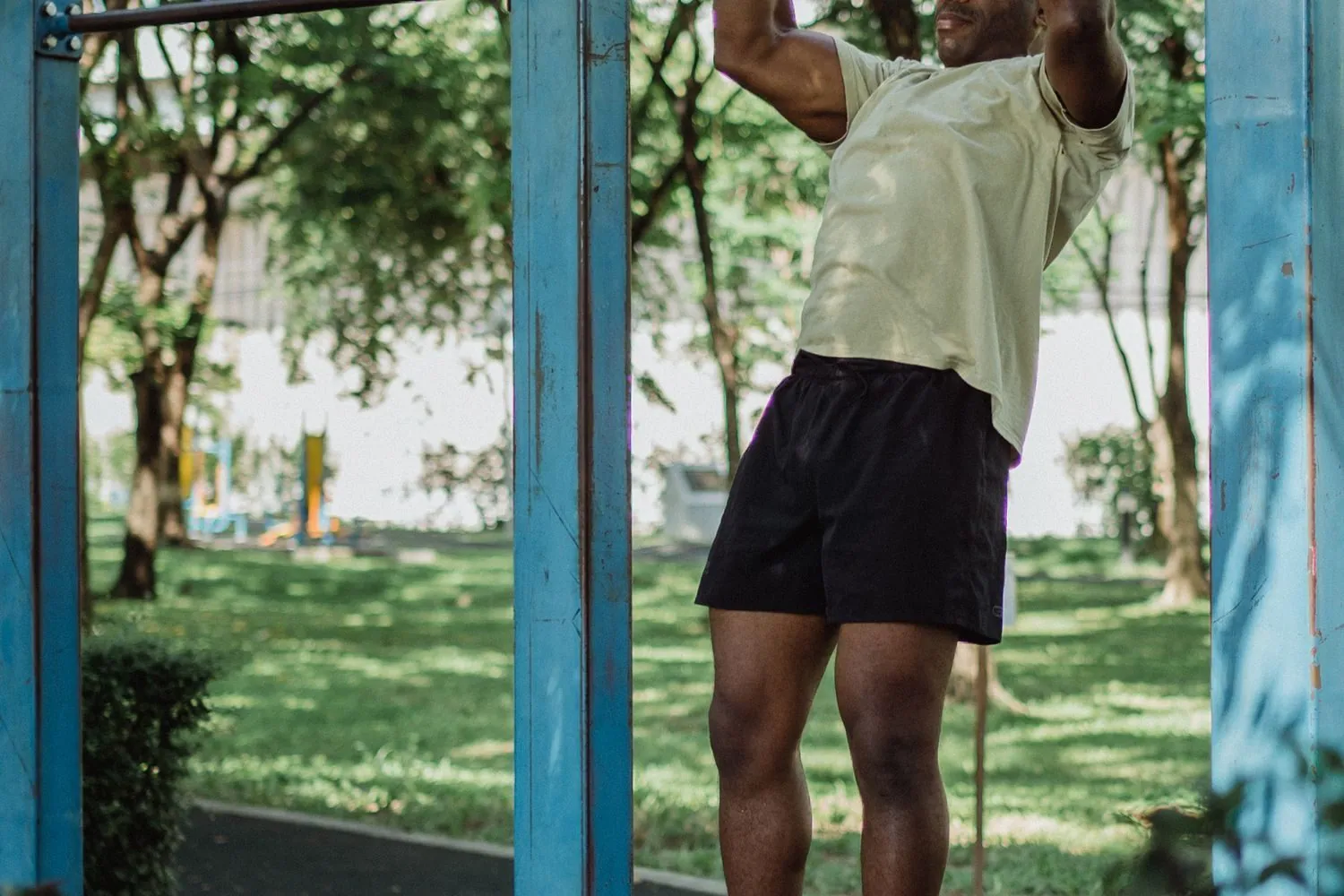
An advanced calisthenics workout typically revolves around strict pull-ups, dips, pistol squats and eventually muscle-ups, which combine a pull-up and a dip in one movement. Treating these as beginner goals is where frustration and injury come from. Earn each step, and if you plateau at one for three or four weeks, add a rep, slow the tempo or add a pause before jumping ahead.
Fixing the usual problems: sore wrists, no pull-up, stalled reps
My wrists hurt in push-ups. Do wrist rocks and circles before every session, spread your fingers wide and press through the whole palm. Push-up handles keep wrists straight too. Sharp or lasting pain is a reason to stop and get it checked.
I cannot do a single pull-up. That is normal. Most beginners have little pulling strength. Spend four to six weeks on dead hangs, inverted rows and slow negatives (jump or step to the top, lower yourself over 3 to 5 seconds). Pull-ups usually come after that, though the timing varies a lot from person to person.
My reps are stuck. Check three things: sleep, protein and rest days. Then adjust one variable at a time, such as slower lowering, a one-second pause at the bottom, or an extra set. Do not change everything at once.
Two more habits to avoid: jumping to an advanced move because it looks impressive online, and rushing reps. Slower and cleaner beats faster almost every time.
Calisthenics at home for women, desk workers and people over 40
The same plan works for almost everyone, with small adjustments. Women often find the first pull-up takes longer because starting upper-body pulling strength is usually lower; that is a training gap rather than a limit, so spend longer on rows, hangs and negatives. Desk workers should add upper-back and hip work: extra rows, glute bridges and a hip stretch, since long sitting tightens hips and rounds shoulders.
If you are over 40, returning after a long break or carrying a joint niggle, begin with easier versions (incline push-ups, chair squats), add reps before difficulty, and give yourself two rest days between early sessions. Warm up longer and stop any exercise that causes sharp pain.
See your doctor before starting if you have heart disease, uncontrolled blood pressure, diabetes on medication, are pregnant or recently postpartum, or are recovering from an injury or surgery. Stop immediately and get medical advice for chest pain, dizziness or unusual breathlessness.
When does a coach make sense?
You can make real progress alone with the plan above. A coach helps when you plateau, feel unsure about form, or want progressions matched to your body, schedule and injury history.
Want your progressions checked on video? Book a session of Fitstrot 1-on-1 personal training and get a calisthenics plan built around your level, space and weekly time.
Frequently asked questions
What is a good calisthenics workout at home?
A good one covers a push, a pull, a squat, a lunge or hinge, and a core exercise, done three times a week. Incline push-ups, bodyweight squats, inverted rows, reverse lunges and planks, 3 sets each with 45 to 60 seconds rest, cover every major pattern in about 30 to 35 minutes.
How do I start calisthenics at home as a complete beginner?
Pick versions of each exercise you can do for 8 to 12 clean reps, train three non-consecutive days a week, and warm up for 5 minutes. Move to a harder version only when you reach the top of the rep range on every set. Expect noticeable strength gains in roughly four to six weeks of consistent training.
Can you build muscle with calisthenics alone?
Yes, especially as a beginner or intermediate. Harder progressions such as archer push-ups, pistol squats and weighted dips with a loaded backpack keep challenging muscle well past the beginner stage. Very advanced trainees eventually need extra resistance to keep adding size, and adequate protein and sleep matter as much as the exercises.
Is calisthenics better than a home dumbbell workout?
Neither is strictly better; they train strength differently. Calisthenics builds relative strength, mobility and control with no equipment cost, while dumbbells allow smaller, more precise load increases. Many people combine both across a week, for example calisthenics for push and pull skills and dumbbells for extra leg or shoulder work.
Can you do calisthenics every day?
Beginners should not. Muscles and tendons adapt during rest, and daily full-body sessions often lead to sore wrists, elbows and shoulders. Three to four strength days a week with rest or light walking in between works better. Advanced trainees can train more often only by splitting push, pull and leg days.


