
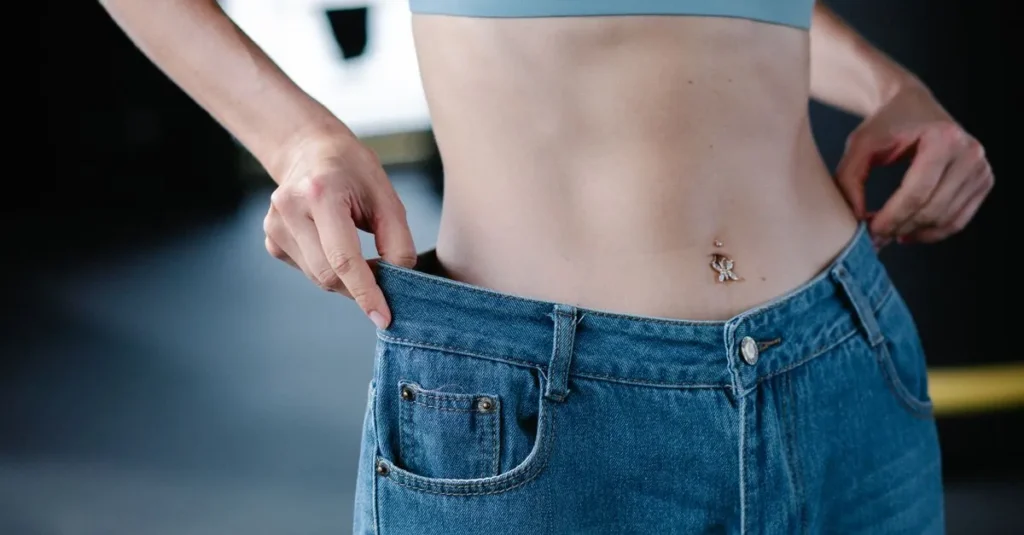
Every before and after weight loss photo hides months of ordinary days: some good weeks, some flat ones, and a few where nothing seemed to move. Most people see the finished picture and assume the process was fast and straight. It rarely is. This guide shows what realistic change looks like at 4 weeks, 12 weeks and 6 months, how to track it with photos and a tape measure, and why your own trend line matters more than anyone else’s transformation reel.
How long does it take to see a before and after weight loss change?
At a sustainable pace of roughly 0.25 to 0.5 kg per week (a little more if you have a lot to lose), most people notice clothes fitting differently by weeks 3 to 4, a visible difference in photos by weeks 8 to 12, and a clear transformation around 6 months. Faster claims usually involve water loss, a heavier starting weight, or conditions that are hard to repeat.
The table below turns that into a month-by-month picture. Treat every figure as a rough range, not a promise: age, sleep, stress, starting weight, medical conditions and consistency all move the numbers.
| Timeframe | Typical scale change (about) | What you may notice | What the camera may show |
|---|---|---|---|
| Weeks 1-2 | 1-2 kg, mostly water and gut contents | Less bloating, better energy, steadier appetite | Usually nothing yet |
| Weeks 3-4 | 1-3 kg | Waistband looser, face slightly leaner | Subtle change in face and waist |
| Weeks 8-12 | 3-7 kg | Clothes clearly looser, stairs and walks easier | Visible difference in waist, jawline, shoulders |
| Month 6 | 6-13 kg if you stay consistent | Wardrobe change, higher stamina, new strength | The comparison most people post |
| Month 12 | Varies widely; many people plateau and maintain | Habits feel automatic | A change that holds, not a single peak photo |
If someone promises a dramatic before and after in two or three weeks, treat it as marketing, not biology. Crash methods can cost muscle, leave you tired and tend to rebound.
What changes first, and what changes last?
The face, waist and clothing fit usually change before the scale tells the whole story, while stubborn areas such as the lower abdomen, hips or thighs often change last. Where you lose fat first is largely set by genetics and cannot be chosen with spot exercises. Expect an uneven, individual pattern.
A rough order many people report looks like this:
- Early: less bloating, better sleep, more energy, a slightly slimmer face.
- Middle: waist and belt notch change, kurtas, shirts and salwar fit differently, shoulders and arms look more defined if you strength train.
- Late: lower belly, hips and thighs, which often hold on longest. This is normal, not a sign that the plan has stopped working.
Posture is the quiet contributor most comparisons miss. As you get stronger and carry less weight, you tend to stand taller, and that alone can make a photo look more transformed than the fat loss accounts for. For a longer view of the journey from unfit to confident, see our guide on fat to fit.
Which tracking method should you trust: scale, tape, photos or clothes?
No single measure is reliable alone. Use the scale for trend, a tape for waist and hips, photos for shape and clothes fit for real-life proof. Comparing all four every 2 to 4 weeks catches progress that one measure misses, especially if you are lifting weights or resting between workouts.
| Method | What it tells you | How often | Main weakness |
|---|---|---|---|
| Weighing scale | Overall weight trend | Same morning, 1-2 times a week, judge the weekly average | Swings of 0.5-1 kg a day from water, salt and meals |
| Tape measure (waist, hips) | Fat loss around the middle even when weight stalls | Every 2-4 weeks | Inconsistent placement changes the number |
| Progress photos | Shape, posture, definition | Every 4 weeks | Lighting and pose can fake changes |
| Clothes fit | Real-world change | Whenever you dress | Fabric stretches and shrinks |
| Strength and stamina log | Fitness gains that photos cannot show | Weekly | Needs a simple written record |
One useful reference point for Indian adults: commonly used South Asian waist cut-offs are about 90 cm for men and 80 cm for women, above which health risk tends to rise. Treat these as a conversation starter with your doctor, not a diagnosis.
How to take progress photos you can trust: a step-by-step walkthrough
Consistency matters more than quality. Take photos once every 4 weeks, in the same spot, same light, same clothing and same three angles, ideally first thing in the morning before eating. That removes most of the noise that makes two photos look different when your body has not changed much.
- Pick a spot. A plain wall near a window, with natural daylight from the same direction each time.
- Fix the camera. Place your phone on a shelf or tripod at the same height and distance, roughly at waist level.
- Wear the same thing. Fitted shorts and a sports top, or similar, so fabric does not hide or exaggerate changes.
- Shoot three angles. Front, side and back, standing relaxed. Do not flex or suck in your stomach in one photo and not the other.
- Time it. Morning, after using the toilet, before food and water. Body water and stomach fullness shift through the day.
- Pair with a tape. Measure waist at the navel with the tape snug but not pressing. If the photo looks similar but your waist is down 2 cm, that is real progress.
Weekly photos mostly capture water retention and bloating, so monthly is plenty. If photographing yourself makes you anxious or obsessive, skip photos and use tape and clothes instead.
Myth check: why other people’s transformation photos mislead
Transformation photos are selected, lit and posed to look their best, and they rarely show the starting weight, the age, the time it took or the attempts that came before. Comparing your timeline to a stranger’s best two photos is a fast route to feeling like you are failing when you are not.
Common things a before and after cannot tell you:
- Lighting and pose. Overhead light, a flexed stomach, a tan or a pump from training can change how the same body looks.
- Starting point. A person with 30 kg to lose changes faster in absolute terms than someone with 8 kg to lose.
- Life situation. A student with home-cooked meals and eight hours of sleep faces different conditions from a parent working long shifts with a commute.
- Selection. Nobody posts the 14-month version, or the one where weight came back and had to be lost again more slowly.
A better habit is to compare yourself only with your own photo from four weeks ago. For a male-focused view of what realistic transformations include, see our post on weight loss before and after for men.
Scale stuck but the mirror is changing? A troubleshooting checklist
If the scale has not moved for 2 to 3 weeks but your waist, clothes or strength have improved, you are likely gaining muscle or holding water while losing fat. Check food portions, weekly step count, protein and sleep first before cutting calories further, which usually backfires.
| Date | Weight (kg) | Waist (cm) | Hips (cm) | Photos taken | Workouts this month | Energy (1-5) |
|---|---|---|---|---|---|---|
| Start | _ | _ | _ | Yes | _ | _ |
| Week 4 | _ | _ | _ | Yes | _ | _ |
| Week 8 | _ | _ | _ | Yes | _ | _ |
| Week 12 | _ | _ | _ | Yes | _ | _ |
Copy this log into a notebook or phone notes and fill it in every 4 weeks. Then check these likely causes in order:
- Portions drifting. Rice, roti and oil quantities creep up without notice; measure for a few days.
- Low protein. Too little dal, paneer, eggs, curd or sprouts makes hunger and muscle loss worse.
- Short sleep or high stress. Both raise hunger and cravings.
- Too little strength work. Without it, more of the weight you lose can be muscle.
- Hormonal or medical causes. Thyroid, PCOS or medication effects can slow results. That is a doctor question, not a willpower one.
Before and after for different starting points
Results look different for men, women, new mothers and people over 40, because body fat distribution, hormones, time and recovery differ. Judge progress against your own baseline and health, not a template. Here are the situations where expectations most often need adjusting.
- Women after childbirth. Recovery, sleep loss and breastfeeding change what is safe and realistic. Wait for medical clearance, and see our notes on weight loss after C-section and rapid weight loss after pregnancy, which explain why slow beats fast here.
- People losing a large amount. A big loss over a few months often leaves some loose skin, particularly around the abdomen. Loss that is gradual, with strength training, usually gives skin more time to adapt. Our guide to stretch marks after weight loss covers what is and is not fixable.
- People over 40. Muscle loss is faster with age, so resistance training and enough protein matter more, and progress may be slower than in a 25-year-old.
- Beginners who prefer low-impact movement. Dance and mat-based sessions are a sensible starting point; see Zumba for weight loss and yoga for weight loss for how each contributes.
What does not show in a before and after photo?
Many of the most valuable changes are invisible: better sleep, lower resting breathlessness, stronger legs on stairs, steadier mood, and, if you have had them checked, improved blood pressure, blood sugar or cholesterol. These often matter more for long-term health than the visual change itself.
A simple non-photo scoreboard works well: how many minutes you can walk without stopping, how many push-ups or squats you can do, how well you sleep and how you feel at 4 pm. If those are improving, the plan is working even in weeks when the mirror is unimpressive.
When to see your doctor or a registered dietitian
Speak to a doctor or registered dietitian before starting a calorie deficit if you are pregnant or breastfeeding, under 18, have diabetes, thyroid disease, heart or kidney problems, a history of disordered eating, or take regular medication. Do not change any prescribed medicine on your own.
Also seek advice if you lose weight faster than about 1 kg a week for several weeks, feel dizzy or weak, lose your period, or lose weight without trying. Unplanned weight loss is a medical signal, not a success. Progress photos and measurements can feed anxiety for some people; if tracking harms your mood or eating, pause it and talk to a professional. For a personal food plan, an online nutritionist consultation can build one around your health history.
How do you keep the result once you have it?
Maintenance usually means keeping most of the habits that got you there: regular walking, strength training twice a week, enough protein and a weight range, not a single number. Expect a small drift of 1 to 2 kg and respond early with portions and activity, not a crash diet.
The after photo is not the finish line. Many people regain weight because they treat the plan as temporary. Our guide on how to maintain weight after weight loss covers the habits that make a change last.
Questions people ask about before and after weight loss
How long does it take to see a visible before and after weight loss difference?
Most people notice clothes fitting differently within 3 to 4 weeks and a visible change in photos around 8 to 12 weeks. A fuller transformation often takes about 6 months of consistent effort, though pace varies with age, starting weight, sleep, stress and medical conditions.
Why do some people lose weight faster than others?
Genetics, starting weight and body composition, age, hormones, sleep, stress, activity level and consistency all affect pace. Someone with more to lose often sees larger early numbers. Comparing yourself to your own starting point is more accurate than comparing to another person’s timeline.
Are before and after photos accurate?
Not always. Lighting, posture, clothing, time of day, hydration and even a training pump can change how a body looks without any real change in fat. Photos under identical conditions, taken monthly, together with waist measurements give a far more reliable comparison.
How often should I take progress photos?
Once every 4 weeks is enough for most people. Weekly photos mostly show water retention and bloating, which can hide real progress. Take them in the same place, light, clothing and angles, ideally in the morning, and pair them with a waist measurement.
What matters more than how I look in a before and after photo?
Strength, stamina, sleep, energy, mood and, if you have had them checked, blood pressure, blood sugar and cholesterol. These show whether your habits are sustainable and healthy. A body that looks only slightly different can already be considerably healthier.
Build a plan that fits your body
If you want a plan paced to your health history and tracked against your own numbers, not someone else’s reel, talk to a Fitstrot online weight loss trainer about a personalised plan.


