
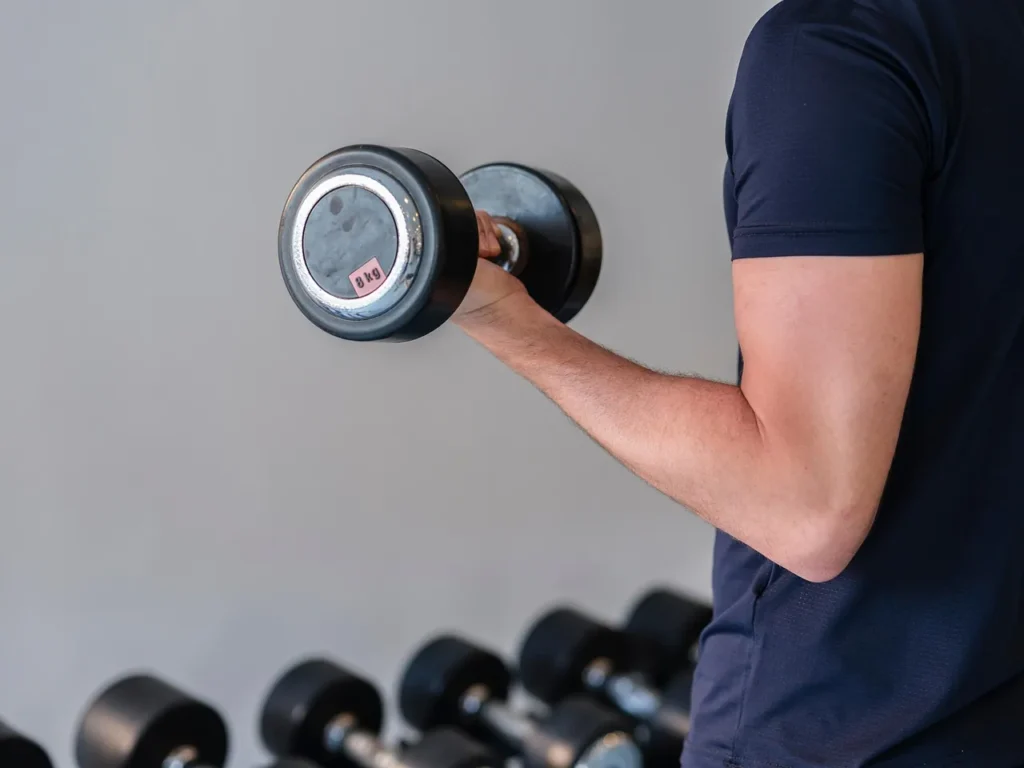
If you are searching how to lose arm fat, you have probably already tried the obvious fix: more tricep kickbacks, more arm circles, more “toning” videos. The frustrating truth is that the arm workout alone is rarely what moves the needle. Upper-arm fat leaves the same way fat leaves everywhere else — through a sustained, full-body calorie deficit — while arm training decides what sits underneath once it goes.
Below: what the controlled arm and limb studies actually measured, a home and gym routine with sets and reps, and an honest look at loose skin and “bingo wings” that no exercise can tighten.
Can you lose fat from just your arms?
No — not selectively. In a 2007 study of 104 adults who trained only one arm for 12 weeks, MRI scans found fat loss spread across both arms, with no meaningful difference between the trained and untrained side. Arm exercise strengthens and shapes the muscle; the fat over it shrinks only as total body fat falls.
That 2007 trial, published in Medicine & Science in Sports & Exercise, is the most arm-specific evidence we have. Kostek and colleagues had 45 men and 59 women train their non-dominant arm under supervision, then compared both arms using MRI and skinfold calipers. A single caliper pinch suggested a small local drop in men, but MRI — which images the entire upper arm rather than one spot — showed a generalised loss in both arms, in both sexes. The authors concluded that spot reduction does not occur as a result of resistance training.
Other limb studies point the same way, sometimes dramatically. When Ramírez-Campillo et al. (2013) had 11 young adults train only one leg with 960–1,200 leg-press reps per session, three times a week for 12 weeks, total body fat mass fell 5.1%. The biggest fat reduction was in the upper extremities — 10.2% — while the trained leg showed no significant change. In other words, the arms got leaner from a leg workout.
| Study (year) | Who | What they trained | What happened to local fat |
|---|---|---|---|
| Kostek et al. (2007) | 104 adults (45 men, 59 women) | Non-dominant arm only, supervised resistance training, 12 weeks | MRI: fat loss in both arms, no significant difference between trained and untrained arm |
| Ramírez-Campillo et al. (2013) | 11 adults, average age 23 | Non-dominant leg only, 960–1,200 reps per session, 3×/week, 12 weeks | Whole-body fat mass −5.1%; arms −10.2%, trunk −6.9%; trained leg no significant change |
| Vispute et al. (2011) | 24 sedentary adults (14 men, 10 women) | 7 abdominal exercises, 2×10 reps, 5 days/week, 6 weeks, no diet change | No significant change in belly fat, waist or body fat %; curl-up endurance improved (47 vs 32 reps) |
The myth: “Tricep kickbacks burn tricep fat”
The logic feels intuitive: the back of the arm jiggles, so working the triceps should burn the fat on top. It does not work that way. When a muscle works, the fatty acids released from fat cells travel through the bloodstream and are used by the whole body. Where your body pulls stored fat from, and in what order, is largely set by genetics, sex hormones and age — not by which muscle is moving. That is why the upper arms are often among the last areas to lean out — normal biology, not a sign of the wrong exercises.
The abdominal version of this myth has been tested directly. In the Vispute et al. (2011) trial, six weeks of daily-ish crunch-style training produced stronger abs and no measurable drop in belly fat when diet stayed the same. Swap “crunches” for “kickbacks” and the principle holds for arms.
So what are arm exercises actually for? Three things that matter a lot:
- Shape. Firmer triceps and shoulders give the arm a defined outline as fat comes off.
- Muscle protection. Dieting without resistance training costs muscle along with fat.
- Calorie burn. Compound moves like push-ups, rows and presses add modestly to the daily deficit.
Where arm fat actually goes: the full-body deficit math
Fat loss happens when you consistently take in fewer calories than you burn. A body fat store of roughly 7,700 kcal per kilogram is the working estimate most coaches use, which means a daily deficit of about 500 kcal leads to roughly 0.45 kg of fat loss a week. That lines up with the CDC’s guidance that people who lose weight gradually — about 1 to 2 pounds (0.45–0.9 kg) a week — are more successful at keeping it off.
In an Indian kitchen, a 400–500 kcal deficit is usually found in a few ordinary places rather than a crash diet:
- Two teaspoons less ghee or oil across the day (about 90 kcal).
- One roti fewer at dinner, or a katori less rice (about 80–130 kcal).
- Replacing the evening namkeen or biscuits with roasted chana or a fruit (about 100–150 kcal).
- Adding a 30-minute brisk walk (about 120–180 kcal, depending on bodyweight).
Protein matters here because you want the weight you lose to be fat, not arm muscle. The ICMR-NIN 2020 nutrient requirements set the adult RDA at 0.83 g of protein per kg of bodyweight per day, and note that people eating mostly cereal-based diets with lower-quality protein need about 1 g/kg. For a 65 kg woman that is 54–65 g daily — easier to reach with dal, curd, paneer, eggs, chana or soya at every meal than most people expect. If you track body composition rather than just the scale, our guide on how to reduce body fat percentage explains how to measure the change properly.
Arm fat exercises: a weekly home and gym routine
The routine below is built around two ideas from mainstream guidance. The CDC adult activity guidelines recommend 150 minutes of moderate activity a week plus at least 2 days of muscle-strengthening work for all major muscle groups. And Mayo Clinic notes that a weight heavy enough to tire the muscle in 12 to 15 repetitions builds strength efficiently for most people, with 20–30 minute sessions at least twice a week, and a rest day between sessions for the same muscle group.
| Day | Exercise | Home version | Gym version | Sets × reps |
|---|---|---|---|---|
| Mon — Push | Chest press | Push-up (wall, knee or floor) | Dumbbell bench press | 3 × 8–15 |
| Overhead press | Water-bottle or band overhead press | Seated dumbbell shoulder press | 3 × 10–15 | |
| Triceps | Chair dips (bent knees) | Cable rope pushdown | 2 × 12–15 | |
| Legs | Bodyweight squat | Goblet squat | 3 × 12–15 | |
| Wed — Pull | Row | Band row anchored at a door | Seated cable row | 3 × 10–15 |
| Vertical pull | Band pull-apart | Lat pulldown | 3 × 10–12 | |
| Biceps | Band or bottle curl | Dumbbell curl | 2 × 12–15 | |
| Legs | Glute bridge | Romanian deadlift | 3 × 10–12 | |
| Fri — Full body | Push | Incline push-up on bed or table | Incline dumbbell press | 3 × 10–12 |
| Pull | One-arm bottle or bag row | One-arm dumbbell row | 3 × 10–12 each side | |
| Triceps | Band overhead extension | Overhead dumbbell extension | 2 × 12–15 | |
| Legs | Reverse lunge | Walking lunge with dumbbells | 3 × 10 each side | |
| Tue, Thu, Sat | Cardio: brisk walk, Zumba, cycling or intervals — 30–45 minutes | — | ||
| Sun | Rest, easy walk or gentle yoga | — | ||
Only one or two moves per day isolate the arms, deliberately. Legs and back are your largest muscles and contribute far more to energy use and muscle retention than a fifth set of curls; your arms still work in every push and pull.
How to lose arm fat at home
You need very little equipment: a set of resistance bands (roughly ₹500–₹1,500 for a light-to-heavy set), two 1-litre water bottles or a backpack loaded with books, and a sturdy chair. The rule is progression: when you hit the top of the rep range with good form, make it harder — wall to knee to floor push-ups, light band to heavy band.

Chair dips load the front of the shoulder heavily. Keep the range short, elbows tracking backward, and swap to band overhead extensions if you feel any pinch.
How to lose arm fat at the gym
The gym’s advantage is simple: precise, gradual overload. Machines and dumbbells let you add 1–2 kg at a time. When all sets hit the top of the rep range for two sessions in a row, increase the load. Cable pushdowns are gentler on the elbows than skull crushers for most beginners.
Walkthrough: your first session, step by step
- Warm up for 5 minutes. Arm circles, band pull-aparts, 20 bodyweight squats, marching on the spot.
- Pick your load. Choose a version you can do for the lower end of the rep range with 2–3 reps left in reserve.
- Do the first set slowly. About two seconds down, one second up, full control.
- Rest 60–90 seconds between sets.
- Write it down. Exercise, load and reps. Without a log you cannot progress on purpose.
- Finish with 5 minutes of easy walking and a light stretch for chest, shoulders and triceps.
Unsure about form, especially with a shoulder history? Fitstrot’s 1-on-1 personal training runs live on video, so a trainer can check your elbows and shoulders at home.
Battle ropes, Zumba and cardio: the calorie side
Strength training shapes the arm; cardio mostly widens the deficit. Brisk walking, cycling, stair climbing, Zumba or intervals for 30–45 minutes all count. Battle ropes feel like an arm workout, but their real value is whole-body calorie burn, not a local effect on arm fat.
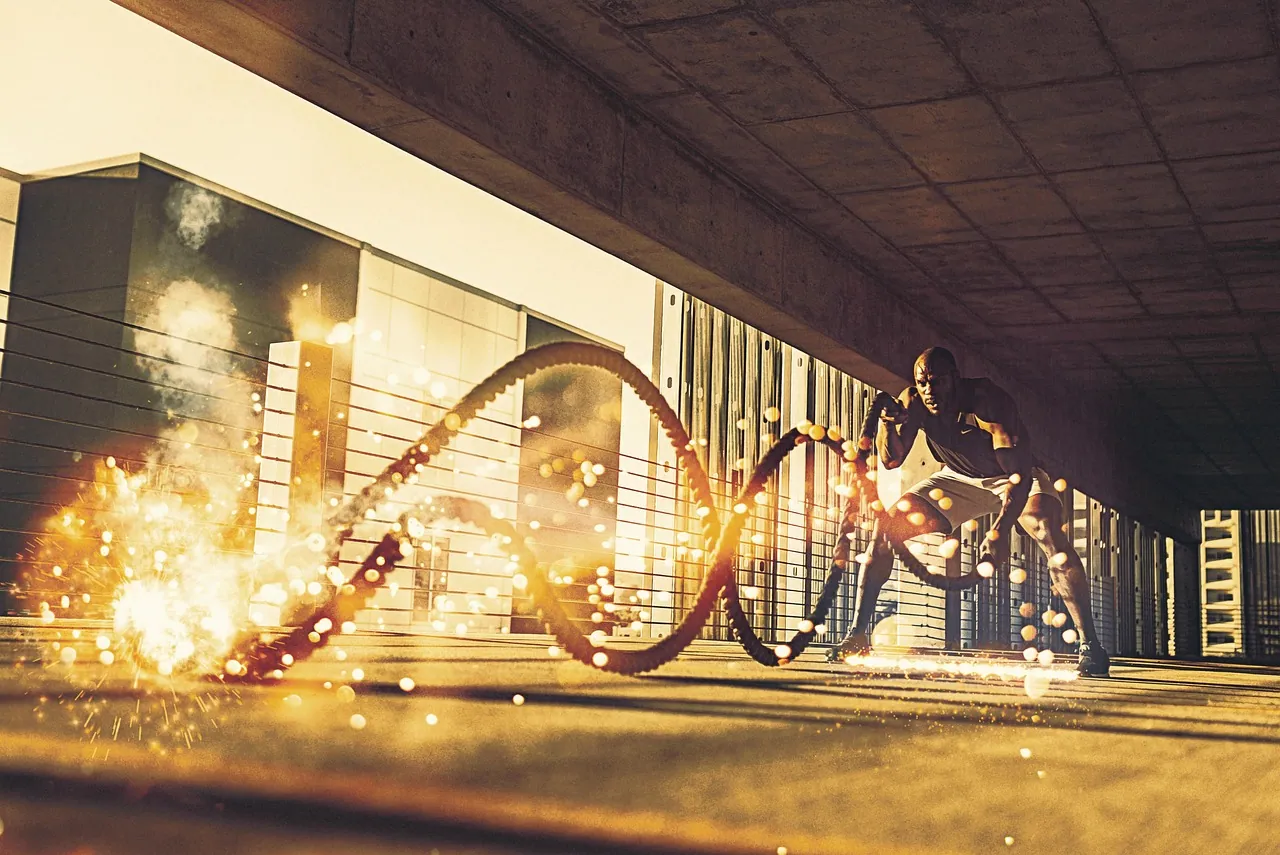
A practical interval session with ropes, a skipping rope or even shadow boxing: 30 seconds hard, 60 seconds easy, repeated 8–10 times after a 5-minute warm-up. Twice a week is plenty for beginners.
The same logic applies to other “problem areas.” If your lower body stores fat the way your arms do, our guide on thigh weight loss covers the same principle for legs.
How to lose arm fat before and after: a realistic 12-week timeline
Online before-and-after photos are often cherry-picked or years apart. The table below assumes a moderate deficit (about 0.25–0.5 kg lost per week), three strength sessions and roughly 150 minutes of cardio a week.
| Timeframe | What usually changes | Realistic body-weight change | What to measure |
|---|---|---|---|
| Weeks 1–2 | Strength rises quickly (mostly nervous-system learning). Scale may drop 1–2 kg, largely water and gut contents. | 0.5–2 kg (not all fat) | Baseline photos, upper-arm circumference at mid-point |
| Weeks 3–6 | Clothes feel looser. Arms feel firmer to touch. Visual change in arms is often small. | 1–3 kg total | Arm and waist tape measure every 2 weeks, same time of day |
| Weeks 7–12 | Upper arms, face and waist visibly slimmer in photos for many people. Tricep shape starts to show at lower body fat. | 3–6 kg total | Photos in the same light, angle and clothing |
| Months 4–6+ | Stubborn areas (often upper arms and hips in women) continue to lean out. Loose skin, if any, becomes easier to judge. | Depends on starting point | Photos, tape, and how strong you are |
How to lose arm fat in 7 days?
You can’t meaningfully reduce arm fat in 7 days. A safe deficit removes around 0.5–1 kg of body fat a week, spread across your whole body, so the upper arms might change by only millimetres. Most quick visible changes in a week come from water and bloating, not fat. A realistic arm change takes 8–12 weeks.
Use the first week to set up the next twelve: baseline photos and an arm measurement, your usual calorie intake, three strength sessions and your protein target. Arms may look slightly tighter after a week of less salt and better sleep — that is reduced water retention, and why “7-day” before-and-after photos deserve suspicion.
Sauna suits, arm wraps, “slimming” creams and crash diets either remove water that comes straight back or cost you muscle, which makes arms look softer, not firmer.
How to lose arm fat in 2 weeks
Two weeks is enough to notice early signs: better push-up numbers, clothes a little looser, perhaps 1–2 kg on the scale. It is not enough for a clearly different arm in photos for most people. For an event in 14 days, control what you can — posture, a well-fitted sleeve, less salt for a few days and good sleep — then keep going afterwards.
Bingo wings and loose skin: what training can and cannot fix
“Bingo wings” is the common name for the soft, hanging tissue under the upper arm. Pinch it: thick and soft is mostly fat and will shrink with overall fat loss; thin and crepey is mostly skin.
Here is the part many fitness pages avoid. Cleveland Clinic states plainly that resistance training improves upper-arm muscle tone, but that exercise can’t tighten loose skin. It lists the usual causes as age-related loss of skin elasticity, losing a large amount of weight, genetics and lymphoedema. Surgical options such as an arm lift are generally considered after very large weight loss — Cleveland Clinic’s excess skin removal overview says body contouring typically follows a loss of 100 pounds (about 45 kg) or more — and only once weight is stable.
For most readers losing 5–15 kg, the practical approach is:
- Lose weight at a moderate pace. Slower loss gives skin time to adapt and protects muscle.
- Fill the space with muscle. Bigger, firmer triceps and shoulders sit under the skin and make the arm look tighter.
- Protect your skin. Sunscreen and not smoking support skin health.
Age adds a second layer. Harvard Health Publishing notes that adults lose as much as 3–5% of muscle mass per decade after age 30. Less muscle under the skin means less structure, which is why arms can look softer at 45 than at 25 even at the same weight — and why strength training becomes more important, not less, with age.
Arm fat by life stage: women, men, new mothers and over-40s
Women
Many women carry a larger share of fat on the upper arms, hips and thighs, and these areas often lean out last. This is normal and does not mean the plan is failing. Measure waist and arm every two weeks; the waist usually moves first. Moderately heavy weights will not make arms bulky.
Men
Men more often store fat around the belly first, so arms may lean out earlier. The 2007 study’s small skinfold drop in men’s trained arm was not confirmed by MRI, so the same plan applies: deficit, protein, compound lifts.
How to lose arm fat after pregnancy
After delivery, get clearance from your doctor before starting strength work — commonly around six weeks after a vaginal birth and often later after a caesarean. Start with light bands and wall push-ups, and keep the deficit gentle if breastfeeding. Our guide to weight loss after a C-section covers the recovery timeline in more detail.
Over 40
Prioritise strength training (three sessions a week is ideal), protein at each meal, and joint-friendly exercise choices: cable or band triceps work instead of deep dips, incline push-ups instead of floor push-ups at first.
Stalled? Troubleshooting arm fat that won’t budge
If you have been consistent for four or more weeks and nothing is changing, work through these checks in order:
- Are you actually in a deficit? Weigh and log everything for 7 days, including oil, sugar in chai and weekend meals. Weekend eating often cancels a weekday deficit.
- Is the scale flat but tape shrinking? That is progress. Muscle gain and water shifts can mask fat loss for a few weeks.
- Are you getting stronger? If the numbers in your log have not moved in three weeks, increase load or reps.
- Too aggressive? Very low intakes lead to fatigue, missed workouts and weekend binges.
- Medical factors. Unexplained weight gain, fatigue or swelling in the arms can relate to thyroid issues, medication or lymphoedema. See a doctor rather than training harder.
How to lose arm fat fast (the honest version)
“Fast” safely means the upper end of the recommended pace — about 0.5–1 kg a week — and doing all four levers at once: a consistent 400–500 kcal deficit, protein at every meal, three strength sessions a week and 150+ minutes of cardio. That is the fastest route that keeps the muscle that gives arms their shape. Anything faster tends to take muscle with it and rebound.
Frequently asked questions
Do arm exercises burn arm fat?
Not specifically. A 12-week study of 104 adults who trained one arm found MRI-measured fat loss in both arms equally. Arm exercises build the muscle under the fat and add to your daily calorie burn, but the fat itself reduces only as your total body fat falls.
How long does it take to lose arm fat?
Most people notice a visible change in their upper arms after 8–12 weeks of a moderate calorie deficit and regular strength training. Upper arms are often one of the last areas to change, especially in women, so progress may continue for several months.
Can I lose arm fat without losing weight?
Partly. If you are new to strength training, you can build muscle and lose some fat at the same time, so arms look firmer while the scale barely moves. For substantial arm fat loss, though, you need to lower total body fat, which usually means some weight loss.
Will lifting weights make my arms bigger?
Not in the way most people worry about. With a calorie deficit and moderate weights, arms usually look smaller and firmer as fat goes down and muscle tone improves. Building noticeably large arms takes years of targeted training and eating in a surplus.
Are push-ups good for arm fat?
Push-ups are excellent for strengthening the chest, shoulders and triceps, and they scale from wall to floor. They do not burn arm fat directly, but they build the muscle that shapes the arm as overall fat loss happens.
Can loose arm skin go away with exercise?
Exercise improves muscle tone underneath the skin but cannot tighten loose skin itself, according to Cleveland Clinic. Losing weight gradually, building muscle and protecting your skin help. After very large weight loss, an arm lift is sometimes considered once weight is stable.
Want a coach to set your calorie target and check your push-up form on live video? Book a session with a Fitstrot online weight loss trainer and get a 12-week plan built around your routine, your food and your equipment at home.


