
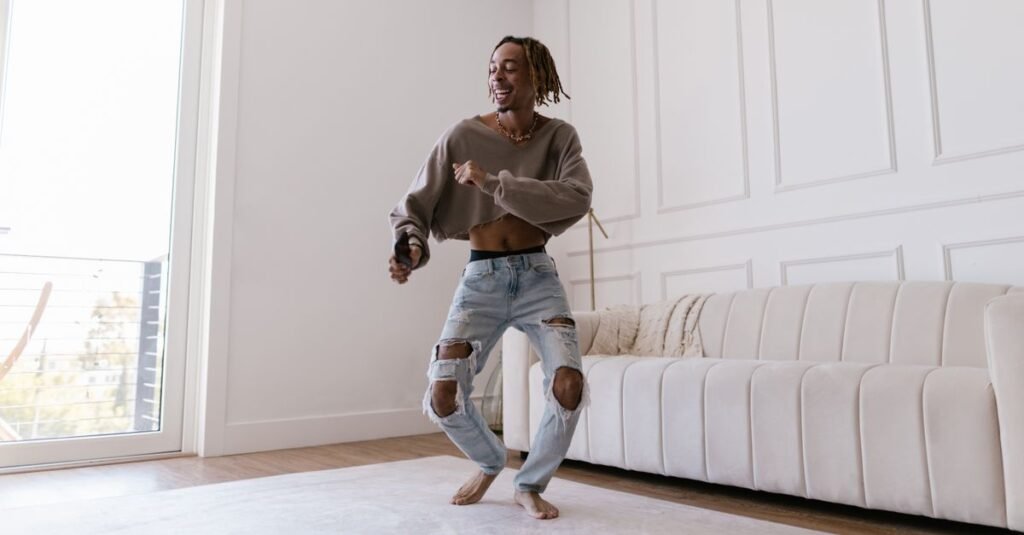
Yes, you can do a full Zumba workout at home without any equipment. All you need is about 2 x 2 metres of clear floor, a pair of indoor trainers and music you like. Nothing else is required: no weights, no step platform and no mat. What decides whether home Zumba works is how you set up the room, how hard you push when nobody is watching and how slowly you build volume in the first month.
This guide covers all three. It is written for Indian homes, where most floors are vitrified tile, marble or kota stone, a ceiling fan hangs a little lower than your fingertips and a neighbour lives directly below you. You will get a floor-by-floor safety table, a 30- and 45-minute no-equipment routine, realistic calorie numbers from published studies and a four-week plan that keeps your knees intact.
Can You Do Zumba at Home Without Any Equipment?
Yes. Zumba is a bodyweight dance format, so the music and your own movement provide the whole stimulus. A 2016 study in the Journal of Sports Science found that women following Zumba DVD workouts at home burned 5.6 kcal per minute, against 6.8 kcal per minute in live classes. The researchers concluded that both formats were suitable for maintaining fitness.
That study, by Delextrat and Neupert (2016), also explains why some people get less out of home sessions. In live classes, participants spent 14.7% of the workout above 85% of their heart-rate reserve. With the DVD, that figure dropped to 1.7%. Home exercisers didn’t lack equipment; they eased off when nobody was watching. The gap was also smaller in women who scored higher for autonomy. If you are a self-starter, home Zumba can come close to a class. If you rely on an instructor’s energy, you need a few tricks to keep the intensity up, and those are covered below.
Equipment is optional. Zumba Toning uses light sticks, and some people hold 500 ml water bottles, but neither is needed for the cardio benefit.
Setting Up Your Room: Space, Floor and Ceiling Fan
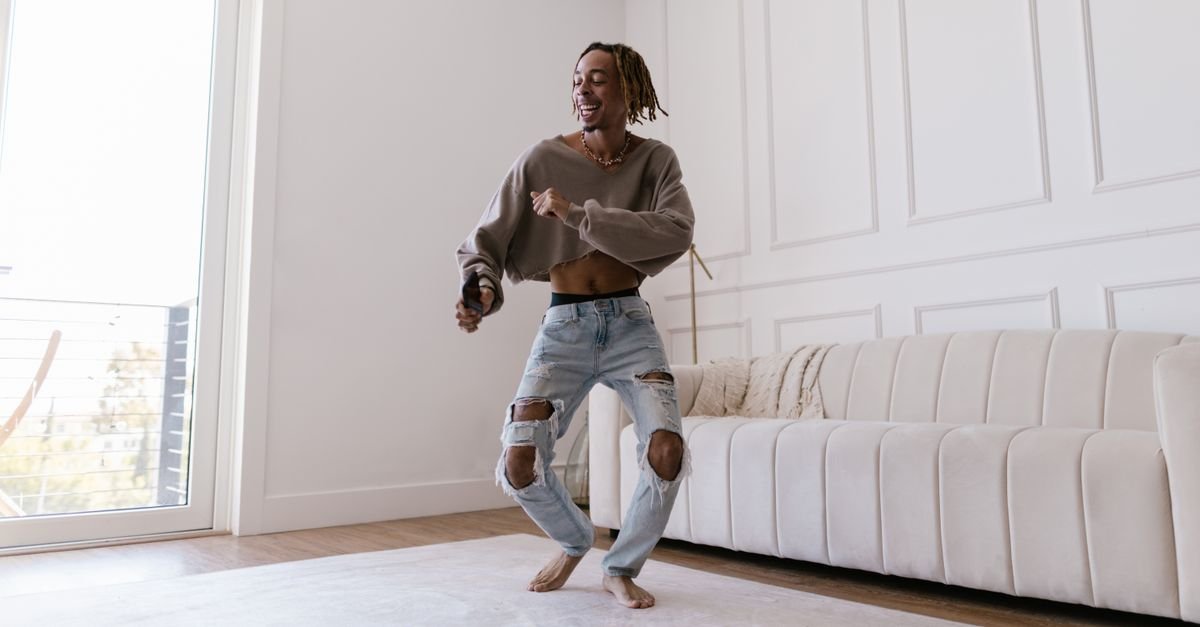
Before you press play, walk through this checklist. It takes five minutes and prevents most home-workout accidents.
- Floor area: aim for about 2 x 2 metres (roughly 6 x 6 feet). That gives you two side-steps in each direction and room to swing your arms out.
- Overhead clearance: stand under your workspace and raise both arms straight up. If your fingertips come within a hand’s width of the ceiling fan blades, move the workout spot or switch the fan off and use a pedestal fan. Zumba has a lot of overhead arm work, and a spinning fan blade is a serious hazard.
- Furniture corners: push the centre table to the wall. Sharp glass or wood corners at shin height are the most common cause of home-workout bruises.
- Loose dhurries and runners: remove them. A cotton dhurrie on a polished tile floor slides when you pivot.
- Screen position: put the phone or laptop at chest height, 2 to 3 metres in front of you. Looking down at a phone on the floor rounds your back and pulls your eyes off your feet.
- Air and water: open a window, keep 500 to 750 ml of water within reach, and in summer avoid the 12 to 4 pm window when rooms are hottest.
Which Indian Floor Is Safe for Zumba?
Floor type matters more than any gear you could buy. Zumba combines quick pivots, side-steps and small hops. A floor that grips too much twists your knee, and one that is too slick takes your feet out from under you. A 2013 survey of Zumba participants in Hawai’i found that 29% had a Zumba-related injury. The knee accounted for 42% of those injuries and the ankle for 14%.
| Floor type | Grip for pivots | Impact on joints | Main risk | Simple fix |
|---|---|---|---|---|
| Vitrified / glazed tile | Slippery, worse with sweat or socks | Hard | Feet sliding on lateral moves | Rubber-soled indoor trainers; wipe sweat drops between songs |
| Polished marble | Very slippery | Very hard | Falls; heel pain from repeated hops | Low-impact versions of jumps; never in socks |
| Kota / granite stone | Moderate | Very hard | Shin and heel soreness | Cushioned shoes; limit jumps to the last 2 songs |
| Wooden / laminate | Good, smooth pivot | Slight give | Few; best home surface | Standard trainers |
| Carpet or thick rug | Grabs the shoe | Soft | Knee twist when the foot sticks mid-turn | Avoid; if unavoidable, replace pivots with step-touches |
| Yoga mat | Very sticky | Soft but unstable | Ankle rolls on the mat edge; knee torque | Use the mat only for the cool-down stretch |
The yoga-mat row surprises most people. A mat is built to stop your feet from moving. In Zumba, your feet are supposed to turn. Keep the mat rolled up until the final stretch.
Zumba Shoes: Do You Really Need Them?
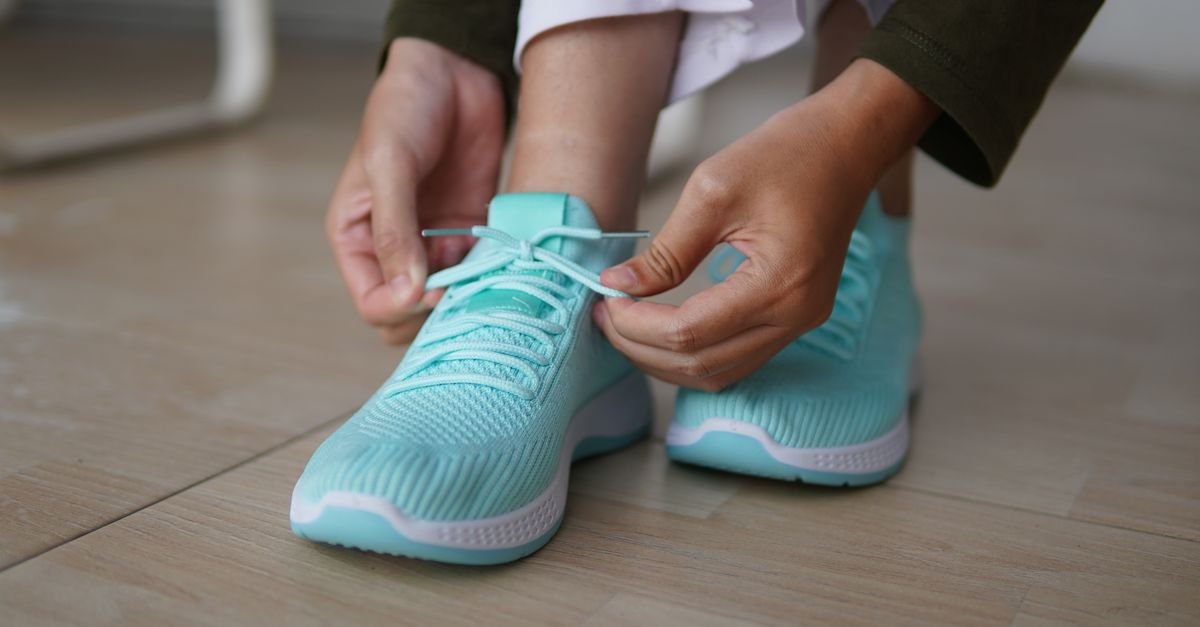
You don’t need branded Zumba shoes, but you do need shoes. A clean pair of cross-trainers or court shoes with a fairly smooth, non-marking sole works for most people. Heavy running shoes with deep, lugged treads are a poor choice because they grip the floor on turns, and the knee absorbs the twist. If your trainers stick, pivot on the ball of the foot and let the heel lift. Working barefoot on marble or tile is uncomfortable on the joints, and socks alone are a slip hazard, so keep them for the cool-down.
Zumba Exercise at Home: The 30- and 45-Minute No-Equipment Routines
Both routines use the same structure. Warm up gradually, build through medium-intensity songs, peak in the middle, then come down. Mayo Clinic suggests warming up for 5 to 10 minutes and cooling down for about 5 minutes, so that your heart rate and blood pressure rise and settle gradually. Each block below is measured in songs. Most dance-fitness tracks run 3 to 4 minutes, so one song is one “set”.
For intensity, use the CDC’s 0 to 10 effort scale and talk test. Moderate effort is about 5 to 6, where you can talk but not sing. Vigorous effort starts at about 7 to 8, where you can only say a few words before taking a breath.
| Block | 30-min version (songs) | 45-min version (songs) | Moves | Effort (0-10) | Rest | Form cue |
|---|---|---|---|---|---|---|
| Warm-up | 2 (about 6 min) | 2 (about 7 min) | March, step-touch, shoulder rolls, hip circles | 3-4 | None | Small range first; let arms join after the first minute |
| Merengue / Bollywood build | 2 | 3 | Merengue march, grapevine, side-to-side with claps | 5-6 | 15-20 s sip between songs | Knees soft, never locked |
| Salsa / cumbia block | 2 | 3 | Salsa basic, cumbia step, cha-cha | 6 | 15-20 s | Pivot on the ball of the foot, not the heel |
| Peak (reggaeton / bhangra) | 1 | 2 | Bhangra shoulder bounce, reggaeton stomp, low-impact jacks | 7-8 | 30 s walk-around | Land softly heel-down; swap jumps for step-outs on marble |
| Toning song | 0 | 1 | Squat-and-reach, alternating lunges to the beat | 6 | 20 s | Knee tracks over second toe |
| Cool-down | 1 (about 5 min) | 1-2 (about 6 min) | Slow sway, deep breaths, then calf, quad and hamstring stretches | 2-3 | None | Hold each stretch 20-30 s; no bouncing |
If you are new to the steps named above, learn them slowly first with our step-by-step Zumba dance moves guide. If you want a fully choreographed half-hour, the 30-minute Zumba workout lays out a complete song-by-song session.
Building a Zumba Workout at Home With a Bollywood Playlist
Zumba’s own rhythms are merengue, salsa, cumbia and reggaeton, but the format works on any music with a steady beat. Bollywood and bhangra tracks keep many Indian beginners moving longer simply because they know the songs. A practical rule: pick tracks of roughly 120 to 130 beats per minute for the warm-up and cool-down, and faster tracks for the peak. Arrange them in a single playlist in the order of the table above, so you never stop to search for the next song with a racing heart.
Zumba Calories Burned in 30 Minutes: What the Data Actually Shows
A 30-minute Zumba workout at home burns roughly 165 to 250 kcal for most adults weighing 57 to 84 kg. The exact figure depends on body weight and on how hard you work. Women in a 2016 study burned 5.6 kcal per minute on home DVD workouts, about 168 kcal per 30 minutes, and 6.8 kcal per minute in live classes.
No calculator gives an exact number, so the table below shows the range from three independent sources rather than a single invented figure. The Harvard numbers are converted from pounds (125, 155 and 185 lb).
| Source and activity | ~57 kg | ~70 kg | ~84 kg |
|---|---|---|---|
| Harvard Health: low-impact aerobics, 30 min | 165 kcal | 198 kcal | 231 kcal |
| Harvard Health: high-impact aerobics, 30 min | 210 kcal | 252 kcal | 294 kcal |
| Delextrat 2016: Zumba DVD at home (women, mean 56.9 kg) | ~168 kcal | not measured | not measured |
| Delextrat 2016: live Zumba class (same women) | ~204 kcal | not measured | not measured |
| For comparison: walking at 5.6 km/h, 30 min | 107 kcal | 133 kcal | 159 kcal |
Sources: the Harvard Health calories-per-30-minutes table and Delextrat and Neupert (2016). For a longer session, a 2016 study of physically inactive women in London measured 411 kcal, 51 minutes of moderate-to-vigorous activity and about 6,770 steps across a one-hour Zumba class.
The gap between the DVD and class rows comes from intensity, not equipment. To close it, treat the peak songs as genuinely hard (7 to 8 on the effort scale), make your arm movements bigger and travel further on each side-step. Small, lazy movements are the main reason a home session falls short of a class.
Myth: “Zumba Workout at Home for Weight Loss Works on Its Own”
This is the claim that brings most people to home Zumba, and the evidence doesn’t back it in its simple form. A 2020 systematic review and meta-analysis of randomised trials found that Zumba significantly improved aerobic fitness (VO2peak, effect size 0.53). Its effect on fat-mass percentage was small and not statistically significant (-0.25). The authors stated directly that they could not conclude Zumba reduces body mass.
Here is a fair reading of that result. Zumba makes your heart and lungs fitter, and it is enjoyable enough that people keep doing it, which matters more than any single workout. But 170 to 250 kcal per session is easily cancelled out by two extra rotis with ghee, or a samosa and sweet chai. If fat loss is your goal, home Zumba is the activity half of the plan. The food half has to come from portion control and enough protein across your Indian meals. A Fitstrot online nutritionist consultation can build that plan around your own thali, so the two halves work together. Treat any promise of losing a set number of kilos from dance workouts alone as marketing, not physiology.

Your 4-Week Zumba for Beginners at Home Progress Plan
The Hawai’i injury survey found one pattern that matters here. Injured participants were taking more classes a week than uninjured ones, 3.8 against 2.7, and each extra weekly class was linked to higher injury odds (odds ratio 3.6). Their age, how many months they had been doing Zumba and the length of each class made no significant difference. Weekly frequency was the risk, so build frequency gradually.
The end target is the CDC’s adult guideline of 150 minutes of moderate activity a week, or 75 minutes of vigorous activity, plus at least 2 days of muscle-strengthening. The NHS guidelines for adults aged 19 to 64 list dancing as moderate activity and aerobics as vigorous, which fits Zumba’s mix of easier and peak songs.
| Week | Sessions | Length | Weekly minutes | Peak effort | Rest days | Focus |
|---|---|---|---|---|---|---|
| 1 | 3 (e.g. Mon, Wed, Sat) | 20 min | 60 | 6 | 4 | Learn the 4 base steps; no jumps |
| 2 | 3 | 30 min | 90 | 6-7 | 4 | Add arms fully; one peak song |
| 3 | 4 | 30 min | 120 | 7 | 3 | Bigger travel on side-steps; add the toning song once |
| 4 | 4 (3 x 30 + 1 x 45) | 30-45 min | 135 | 7-8 | 3 | First 45-minute session; check knees the next morning |
From week 5, add a fifth short session or a second 45-minute one to pass 150 minutes. Use two non-consecutive days for strength work such as squats, push-ups against the wall and glute bridges. For how many sessions suit different goals over the long term, see how often you should do Zumba. Mild muscle soreness on day two is normal. Sharp pain in the knee or ankle, or pain that changes the way you walk, is a signal to stop and get it checked.
Troubleshooting: Common Home Zumba Problems and Fixes
“My downstairs neighbour complains.”
Most of the noise comes from jumps and stomps. Replace every hop with a step-out or a heel lift, and turn reggaeton stomps into a firm step without the drop. A low-impact session still counts as moderate activity if your arms stay big and your travel wide.
“I lose energy halfway through.”
This is the DVD effect from the 2016 study. Fix it with structure, not willpower. Set the playlist in advance, keep the peak song in the middle rather than at the end, and use the talk test. If you can still sing along during the peak, you are below a 7 on the effort scale.
“My knees ache the next day.”
Check three things in this order. First, your shoes: is the tread grabbing the floor? Second, your pivots: are you turning on a planted heel? Third, your frequency: did you jump from 2 to 5 sessions in one week? In most cases the cause is one of these three.
“I can’t follow the steps fast enough.”
In any Zumba dance workout for beginners, do the feet only for the first two weeks and add arms afterwards. Or march in place while the instructor travels and join on the next repeat.
“The room gets too hot.”
Train before 9 am or after 6 pm in summer, use a pedestal fan rather than the ceiling fan if clearance is tight, and sip water between songs. Stop if you feel dizzy, nauseous or unusually breathless.
Who Should Adapt Home Zumba?
Zumba Workout at Home for Ladies Over 40 and After Pregnancy
Women make up most home Zumba participants in India, and needs change with life stage. If you are in perimenopause or menopause, keep the low-impact versions on stone floors, since heel and knee soreness tend to build up. After delivery, wait for your doctor’s clearance before returning, then start with week 1 of the plan above, regardless of your fitness before pregnancy. If you notice leaking during jumps, that is a pelvic-floor signal, not a reason to push through. Keep the session low-impact and speak to your doctor or a women’s health physiotherapist.
Older Adults and People With Health Conditions
If you have heart disease, high blood pressure, diabetes, joint replacements or haven’t exercised in years, check with your doctor before starting. Start seated or with marching-only versions, and keep effort at 4 to 5 for the first two weeks.
Complete Beginners Who Freeze Without an Instructor
The 2016 DVD study found that people who scored higher for autonomy lost less intensity when training alone. If you know you need someone setting the pace, a live online class gives you that structure without the commute. Fitstrot’s online Zumba classes are led by Yash Pathak, a ZIN Licensed, ACE Certified and Strong Nation Certified instructor. A live instructor can see your form on camera and correct pivots before they become a knee problem.
Frequently Asked Questions
Can I do a Zumba workout at home on a tiled floor?
Yes, but wear rubber-soled indoor trainers, never socks, and wipe up sweat between songs. Vitrified tile and marble are slippery and hard, so use low-impact versions of jumps and pivot on the ball of your foot to protect your knees and ankles.
Is a yoga mat good for Zumba at home?
No. A yoga mat is designed to stop your feet from moving, which turns a Zumba pivot into a knee twist, and the edge of the mat can roll your ankle. Use the mat only for the cool-down stretches.
How many calories does a 30-minute Zumba workout at home burn?
Roughly 165 to 250 kcal for most adults weighing 57 to 84 kg. A 2016 study measured 5.6 kcal per minute for women doing Zumba DVD workouts at home, about 168 kcal per 30 minutes, and 6.8 kcal per minute in live classes.
Can I do Zumba at home barefoot?
It is not recommended on Indian tile, marble or stone floors. Bare feet get no cushioning on hard surfaces and can catch on turns. Trainers with a fairly smooth sole are safer for the main workout. Barefoot is fine for the cool-down stretch.
How often should a beginner do Zumba at home?
Start with 3 sessions of 20 to 30 minutes a week, with rest days in between, and build to 4 or 5 sessions over a month. A 2013 injury survey linked taking more sessions per week to a higher risk of injury, so increase frequency gradually.
Can I lose weight with a Zumba workout at home alone?
Not reliably. A 2020 meta-analysis found that Zumba improves aerobic fitness, but its effect on fat mass was small and not statistically significant. Pair regular home Zumba with a calorie-controlled, protein-adequate diet if fat loss is your goal.
Can I do Zumba in a small flat without disturbing neighbours?
Yes. Replace jumps and stomps with step-outs and heel lifts, and keep your arm movements big and your side-steps wide. A low-impact Zumba session still counts towards the 150 minutes a week of moderate activity recommended for adults.
Is Zumba at home as effective as a live class?
It is effective, but usually a little less intense. In a 2016 study, women burned about 18% fewer calories per minute on home DVD workouts than in live classes. That came from easing off at the peaks, which you can fix with the talk test and a planned playlist.
Want someone to set the pace for you? Book a trial of Fitstrot’s live online Zumba classes. You need only your living room and a pair of trainers.


