
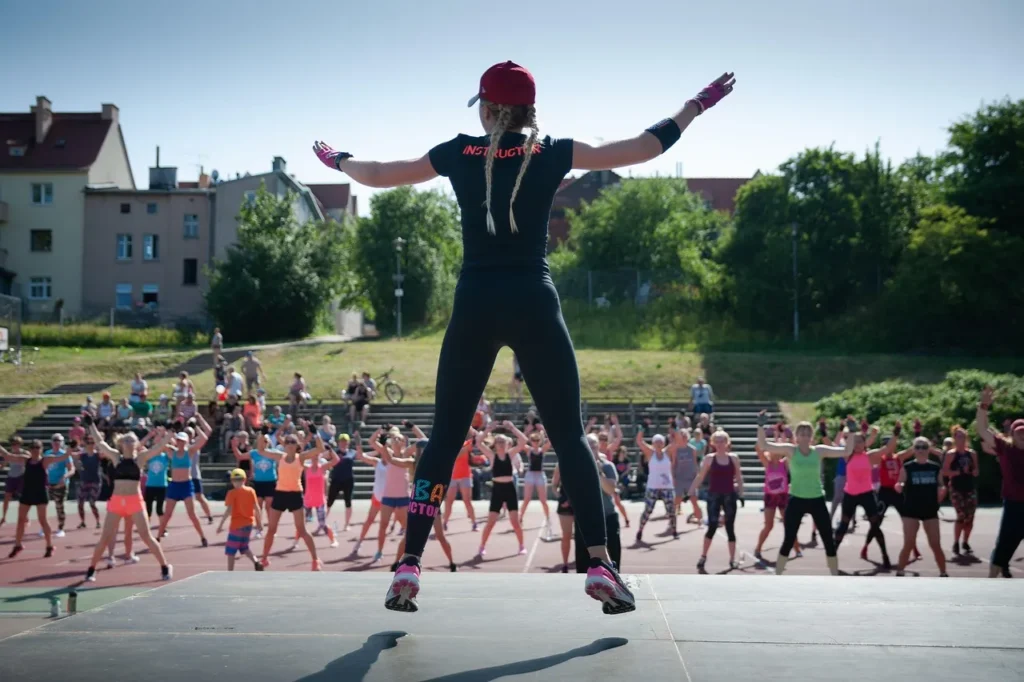
Learning zumba dance moves step by step is far easier than a fast class makes it look. Almost every Zumba routine is built from a small set of footwork patterns taken from four core rhythms: merengue, salsa, cumbia and reggaeton. Once you know about ten of these steps and how they fit into 8-counts, most new songs stop feeling like chaos and start feeling like remixes of moves you already own.
This guide breaks each move down by rhythm, count and form cue, gives you three beginner combos and a four-week practice plan, and fixes the mistakes that make people feel off-beat. It is written for home practice in a normal Indian flat, but it works just as well before your first studio or online class.
What are the basic zumba dance moves?
The basic zumba dance moves are the merengue march, the salsa basic, the cumbia step-back, the reggaeton bounce and the grapevine, plus styling moves such as the belly roll, hip circle, shimmy and cha-cha. Each one fits neatly into an 8-count of music, and most beginner songs repeat just two or three of them in 32-count blocks.
Zumba started in the 1990s as a Latin-inspired dance workout created by trainer Alberto “Beto” Perez in Colombia, built around salsa, merengue and rumba. By 2012 it was being taught at around 110,000 sites in 125 countries, according to a 2012 letter in the Journal of Sports Science and Medicine. Instructors today also mix in hip-hop, Bollywood and belly-dance styling, but the footwork underneath usually traces back to the same handful of rhythms. If you want the bigger picture of how the format works, our explainer on what Zumba is covers the class structure; this page is purely about the steps.
Zumba dance moves names, counts and drills (reference table)
Use this table as a cheat sheet. “Counts” tells you how many beats one full repetition takes. The drill column is written like a workout prescription, because practising a step in short, repeated sets is the fastest way to make it automatic. Play any song at a comfortable tempo and count “1, 2, 3, 4, 5, 6, 7, 8” out loud.
| Move | Rhythm | Counts per rep | Drill (sets × 8-counts) | Rest | Form cue |
|---|---|---|---|---|---|
| Merengue march | Merengue | 1 step per count | 3 × 4 eight-counts | 20 s | Soft knees; let the hip drop on the bent-knee side |
| Merengue side-together | Merengue | 2 counts | 3 × 4 eight-counts | 20 s | Close the feet fully before stepping again |
| Salsa basic (front-back) | Salsa | 8 counts (4 each side) | 3 × 4 eight-counts | 30 s | Small steps, weight fully transfers on 1 and 5 |
| Cumbia step-back | Cumbia | 4 counts (2 each side) | 3 × 4 eight-counts | 30 s | Step back on the ball of the foot, chest stays tall |
| Reggaeton bounce | Reggaeton | 1 bounce per count | 3 × 2 eight-counts | 30 s | Knees drive the bounce, heels stay down |
| Grapevine | Any | 4 counts each direction | 3 × 4 eight-counts | 30 s | Cross behind, not in front; eyes forward |
| Cha-cha (rock + triple) | Cha-cha / salsa | 8 counts (4 each side) | 3 × 4 eight-counts | 30 s | Triple steps are tiny and quick: “cha-cha-cha” |
| Belly roll | Belly dance | 2–4 counts per roll | 3 × 8 rolls | 20 s | Chest lifts first, then belly, then pelvis tucks |
| Hip circle | Salsa / cumbia styling | 4 counts per circle | 2 × 4 circles each way | 20 s | Knees soft, shoulders level and still |
| Shoulder shimmy | Any (styling) | Continuous | 3 × 1 eight-count | 20 s | Shoulders alternate forward and back, not up and down |
Zumba basic steps, one rhythm at a time
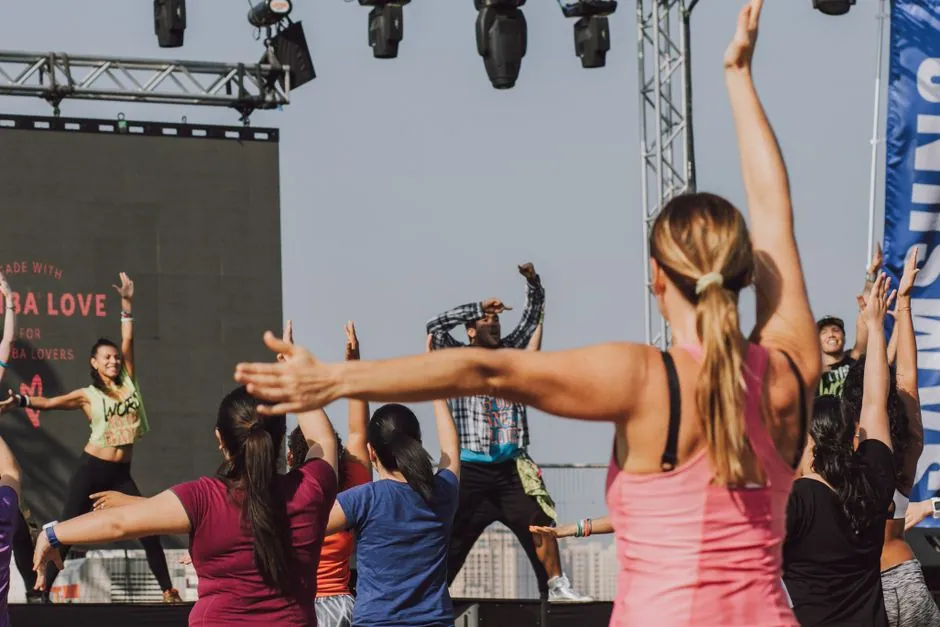
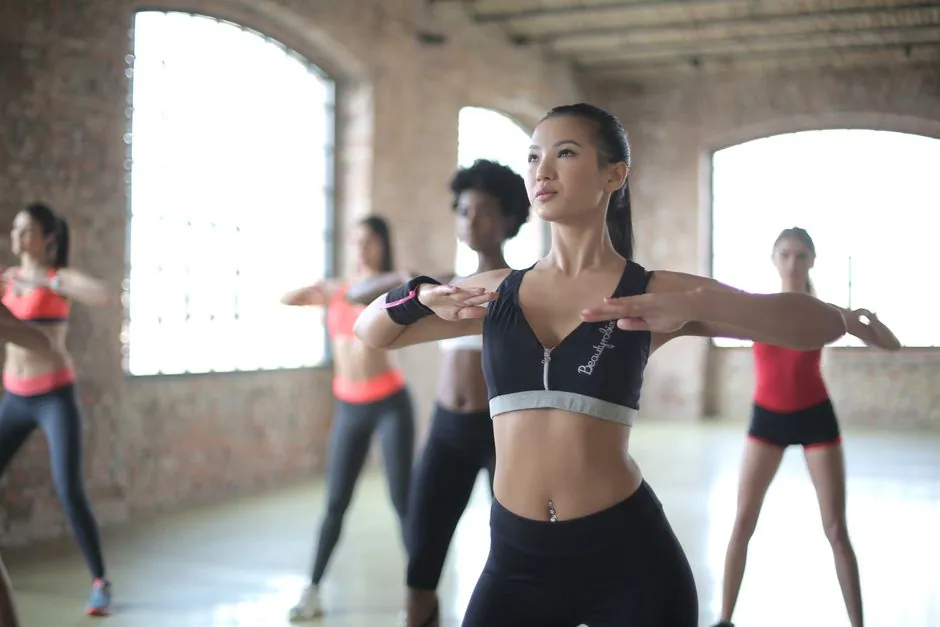
Here is how each move works, counted out. Practise every step first without music, then at a slow tempo, and only then at class speed. The zumba steps with pictures in this guide show the general body position to aim for; the counts below tell you the timing.
1. Merengue march (the first step of nearly every class)
Stand with feet hip-width apart. March in place, one step on every count: right on 1, left on 2, and so on. The trick is the knee. As you step onto one foot, bend the opposite knee slightly and your hip naturally drops on that side, which gives merengue its sway. Do not push the hips; let the knee create it. Once comfortable, travel the march forward for 4 counts and back for 4.
2. Merengue side-together
Step the right foot to the side on 1, bring the left foot to meet it on 2. Repeat to the right for a full 8-count, then go left. Add arms by pumping the elbows at your sides. This step teaches clean weight transfer, which every other move depends on.
3. Salsa basic
Step forward with the right foot on 1, shift weight back onto the left foot on 2, bring the right foot back beside the left on 3, and pause (or tap) on 4. Mirror it on 5–8: left foot steps back on 5, rock forward onto the right on 6, left returns on 7, pause on 8. Keep steps no bigger than a foot-length. A side version (right to the side, replace, together) is common when instructors want to change direction.
4. Cumbia step-back
Cumbia has a steady, almost limping feel. Step the right foot back on a slight diagonal on 1 and rock your weight onto it, then return the right foot to centre on 2. Switch sides on 3–4. The front foot barely moves; it simply receives the weight back. Many instructors add a sweeping arm, as if holding a skirt, or a slight forward lean on each step back.
5. Reggaeton bounce
Set your feet slightly wider than hips. On every count, bend the knees and let the whole body sink, then rebound up. The accent is down, into the floor. Add a slight chest pop or alternating shoulder push once the bounce feels steady. Reggaeton sections are where stomps and sharp arm “hits” appear, so keep your core braced to protect your lower back.
6. Grapevine
Step the right foot to the side on 1, cross the left foot behind the right on 2, step the right foot to the side again on 3, and tap or close the left foot on 4. Reverse to the left on 5–8. Crossing behind is safer and easier to balance than crossing in front.
7. Cha-cha
Rock forward onto the right foot on 1, shift back onto the left on 2, then take three small quick steps in place (right-left-right) on “3 and 4”. Mirror it starting with the left foot. The triple step is the whole flavour of cha-cha, so keep it tiny and light, almost on the balls of your feet.
8. Belly roll and hip circle
For a belly roll, lift the chest, then pull in the upper abdomen, then the lower abdomen, then tuck the pelvis, so a wave travels top to bottom over 2–4 counts. For a hip circle, keep the knees soft and trace a slow horizontal circle with your hips over 4 counts, shoulders staying level. Both are styling moves layered over a simple march or step-touch.
9. Shoulder shimmy
Alternate the shoulders forward and back quickly while keeping the rest of the body relaxed. Beginners often hunch; think “shoulders down and back” before you start. A shimmy is usually added on top of a march or bounce for one 8-count at the end of a phrase.
Fitstrot’s lead Zumba trainer, Yash Pathak, is ZIN Licensed, ACE Certified and Strong Nation Certified, and our live classes teach these same base steps slowly before building them into full songs.
Dance Zumba for beginners: three combos that link the steps
Individual steps only become dance when you chain them. Zumba songs are usually structured in 32-count blocks (four 8-counts), so each combo below is exactly 32 counts. Repeat each one 4 times, rest 30–45 seconds, and do 3 rounds.
Combo A: Merengue warm-up (32 counts)
- Counts 1–8: merengue march in place
- Counts 9–16: merengue side-together, twice to the right and twice to the left
- Counts 17–24: march forward 4, march back 4
- Counts 25–32: march in place with a shoulder shimmy
Combo B: Salsa and grapevine (32 counts)
- Counts 1–16: salsa basic, twice
- Counts 17–24: grapevine right, grapevine left
- Counts 25–32: cha-cha, right then left
Combo C: Cumbia into reggaeton (32 counts)
- Counts 1–16: cumbia step-back, alternating, with sweeping arms
- Counts 17–24: reggaeton bounce in place
- Counts 25–32: reggaeton bounce with a belly roll on 29–32
A 4-week zumba for beginners practice plan
The plan below assumes three sessions a week of 20–30 minutes. It builds footwork first, then combos, then full songs. If you are also attending live classes, count them as sessions. For how many total sessions make sense for your body, see our guide on how often you should do Zumba.
| Week | Moves to drill | Sessions / length | Sets × reps | Rest | Focus cue |
|---|---|---|---|---|---|
| 1 | Merengue march, side-together, salsa basic, grapevine | 3 × 20 min | 3 × 4 eight-counts per move | 30 s | Say the counts out loud |
| 2 | Add cumbia step-back, cha-cha, reggaeton bounce | 3 × 25 min | 3 × 4 eight-counts per move + Combo A × 4 | 30 s | Weight fully on one foot at a time |
| 3 | Add belly roll, hip circle, shimmy; Combos B and C | 3 × 25–30 min | Each combo × 4, 3 rounds | 30–45 s | Add arms only once feet are automatic |
| 4 | All combos back-to-back to 3–4 full songs | 3 × 30 min | 3–4 songs continuous, then combos × 2 | 60 s between songs | Stay on the beat even if arms drop out |
Week 4 lands you at roughly 90 minutes a week. That is a sensible base, but it is still short of the 150 minutes of moderate activity per week that the WHO recommends for adults; the same fact sheet notes that 31% of adults worldwide were insufficiently active in 2022. Walking, yoga or strength work on other days can close the gap.
How hard is Zumba, really? What the studies measured
A typical Zumba class is moderate-to-vigorous exercise. In a 2012 study of 19 young women, a class averaging about 39 minutes kept heart rate at 79% of maximum and burned an estimated 369 kcal (9.5 kcal per minute). A 2015 study of adults averaging 63 years found gentler Zumba Gold classes burned about 198 kcal in 45 minutes.
Mayo Clinic defines moderate exercise as roughly 50–70% of maximum heart rate and vigorous exercise as 70–85%, and suggests estimating maximum heart rate as 208 minus 0.7 × your age (Mayo Clinic, exercise intensity). That puts a standard Zumba class, on average, in the lower part of the vigorous zone for fit young adults.
| Source | Who / what | Session length | Intensity | Energy used |
|---|---|---|---|---|
| Luettgen et al., 2012 | 19 experienced women, average age 19, about 62 kg | 38 min 48 s average (32–52 min) | 79% HRmax; 66% VO2max | ≈369 kcal per class (9.5 kcal/min) |
| Zumba Gold study, 2015 | Adults averaging 63.4 years | 45 min | ≈50% heart-rate reserve | ≈198 kcal per session |
| Mayo Clinic zones | Moderate intensity | — | 50–70% HRmax; can talk, can’t sing | — |
| Mayo Clinic zones | Vigorous intensity | — | 70–85% HRmax; only a few words per breath | — |
The Zumba Gold figures come from a 2015 study in the Journal of Sports Science & Medicine. Treat all these calorie numbers as estimates for the people studied. Your own burn depends on body weight, fitness, how big you make the moves and how many songs you actually keep moving through.
On the broader evidence, a 2016 systematic review in PM&R pooled 11 studies with 586 participants aged 18–65 and concluded that Zumba improves aerobic capacity, with small benefits for body weight and quality of life, but only limited evidence for gains in strength and flexibility.
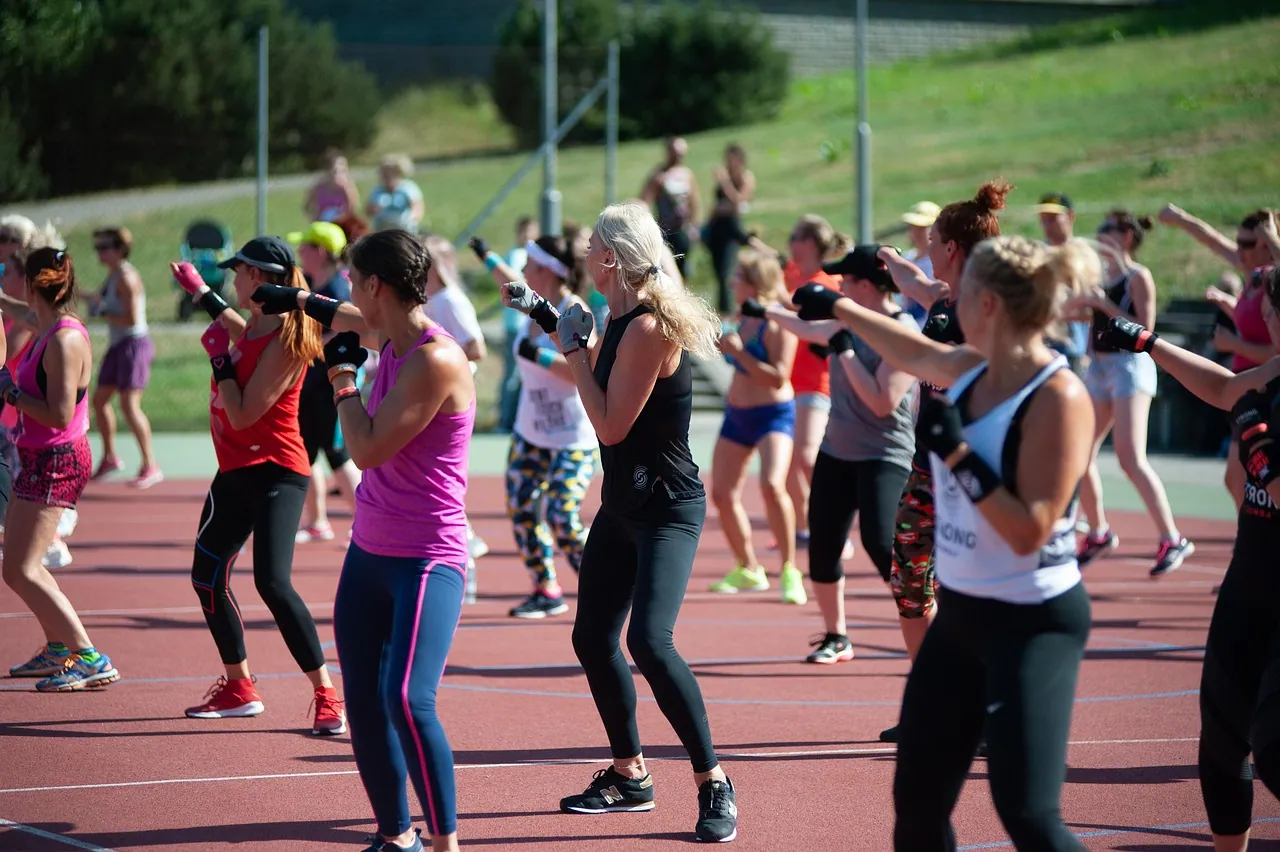
Myth: “You need to be a good dancer to do Zumba”
This is the most common reason beginners delay starting, and it is wrong. The 2012 study above noted that Zumba’s own ethos is that “there is no right or wrong way to do it”, and choreography is deliberately less formal than many group classes. What does matter is safety: knees tracking over toes, a braced core in bouncy sections, and not twisting on a planted foot.
A third myth is that Zumba is only for young women. The Zumba Gold research above involved both men and women averaging 63 years, and the format scales down easily through the low-impact swaps below.
Zumba steps feel off-beat? Fix these 7 mistakes
- Copying arms before feet. Drop the arms entirely for the first few weeks. Feet decide whether you are on the beat.
- Not finding the “1”. Most Zumba music has a strong downbeat every 8 counts. Clap along for 30 seconds before moving, and start each step on that first strong beat.
- Half-transferring weight. In the salsa basic and cha-cha, the weight must fully land on each step. If you can’t lift the other foot, you haven’t transferred.
- Locked knees. Straight legs make merengue look stiff and put more stress on the knees during bounces. Keep a slight bend at all times.
- Pivoting on a stuck foot. Turning with your foot planted on a sticky mat or rubber-soled running shoe twists the knee. Lift the heel slightly or step around the turn instead.
- Steps too big. Shorter steps are faster to recover from, so you stay on count when the song speeds up.
- Skipping the warm-up. The American Heart Association recommends 5–10 minutes of warm-up, longer for more intense activity. A slow merengue march and side-together make a perfect one.
Zumba steps easy on the knees: low-impact swaps
Injury data is worth taking seriously. A 2013 survey of 49 Zumba participants in Hawai’i found 29% reported a Zumba-related injury, with knees accounting for 42% of injuries, and injured participants attended more classes per week (3.8 versus 2.7). Harvard’s Nutrition Source also notes instructors were about seven times more likely to be injured than participants, and advises a 10–15 minute warm-up and supportive dance-fitness shoes.
- Reggaeton bounce: reduce to a small knee pulse with heels grounded, no jumping.
- Jumps and stomps: replace with a step-tap or a heel dig.
- Grapevine: shorten to a step-touch side to side.
- Turns: replace with a four-count march turning in a small square.
- Cumbia step-back: keep the back step short and hold a chair back for balance if needed.
If you have a knee, back or heart condition, are pregnant, or have not exercised in a long time, check with your doctor before starting, and stop if you feel chest pain, dizziness or sharp joint pain.
Zumba for beginners at home: setting up in an Indian flat
Most Indian homes have vitrified tile or marble floors, which are hard and can be slippery. That makes home Zumba perfectly doable, but it needs a few adjustments.
- Space: clear an area of about 2 × 2 metres so you can grapevine and step back without hitting furniture.
- Surface: a firm exercise mat or interlocking foam tiles reduce impact; avoid thick, squishy yoga mats for footwork, because they grip the foot and make pivots risky.
- Shoes: clean indoor trainers with a smooth sole beat bare feet on tiles. Heavy-tread running shoes grip too much for turns.
- Heat and hydration: in summer, open windows or run a fan and keep a bottle of water within reach. Humid Indian summers make you sweat more than you expect.
- Timing: leave at least 1.5–2 hours after a full meal like lunch or dinner. Our post on the best time to do Zumba compares morning and evening sessions.
Who should adapt which moves
Different bodies need different versions of the same step. Older adults and complete beginners can start with merengue, salsa basic and step-touch at low impact; the Zumba Gold research suggests this still reaches moderate intensity. People carrying more body weight should skip jumps for the first month and focus on marching and side steps, which protect the knees and ankles while fitness builds. Anyone post-pregnancy should get clearance from their doctor and avoid high-impact bouncing until the pelvic floor and core have recovered.
Frequently asked questions
What are the 4 basic rhythms in Zumba?
The four core rhythms are merengue, salsa, cumbia and reggaeton. Each has one signature step: the merengue march, the salsa basic, the cumbia step-back and the reggaeton bounce. Most classes also borrow from cha-cha, belly dance, hip-hop and Bollywood.
How long does it take to learn Zumba dance moves?
There is no fixed timeline, but with three short practice sessions a week, many beginners can follow the basic footwork within a few weeks. Styling, arm patterns and fast transitions take longer, and that is normal.
Can I learn Zumba at home without a teacher?
Yes, you can learn the basic steps at home using a count-by-count guide and slowed-down music. A live instructor helps with timing, form corrections and motivation, especially for turns and combinations.
How many calories does a Zumba class burn?
A 2012 study of young women measured about 369 kcal in a class averaging 39 minutes, or roughly 9.5 kcal per minute. A 2015 study of older adults found about 198 kcal in 45 minutes of Zumba Gold. Individual results vary with body weight and effort.
Is Zumba bad for the knees?
Zumba is not inherently bad for the knees, but knees were the most injured site in a 2013 survey of participants. Keep knees soft, avoid pivoting on a planted foot, use low-impact swaps and don’t jump straight to four or more classes a week.
What shoes should I wear for Zumba?
Wear supportive trainers with a smooth sole that lets you turn easily, such as dance-fitness or cross-training shoes. Heavy-tread running shoes grip too much, and bare feet on hard tiles offer no cushioning.
Which Zumba move should a beginner learn first?
Start with the merengue march. It is one step per count, teaches weight transfer and hip movement, and appears in almost every class warm-up. Once it feels natural, add the salsa basic and grapevine.
Want someone to count you in? Join a live Fitstrot online Zumba class and learn these steps at beginner pace, with real-time form cues from a certified trainer.


