
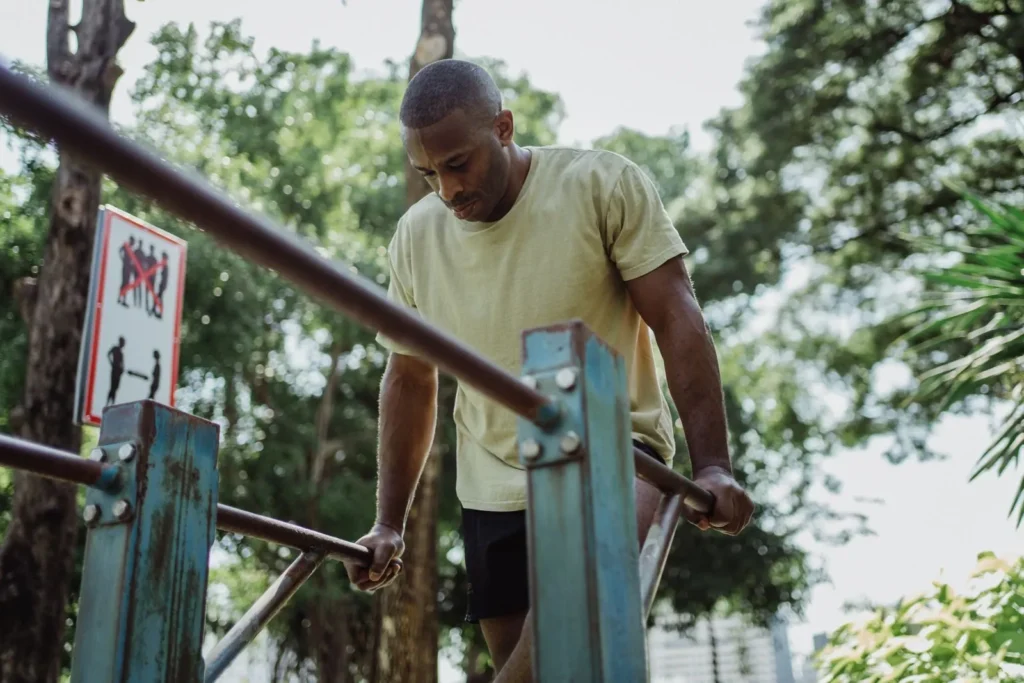
A double bar workout is a bodyweight session on two parallel rails, the same yellow or green dip bars you see in almost every Indian park and outdoor fitness zone. Dips, L-sits, leg raises and support holds on those rails train your chest, triceps, shoulders and core together, and the equipment costs nothing. This guide gives you the exercises, sets and reps, form cues, a 4-week plan and fixes for common problems.
What does a double bar workout train, and who is it for?
A double bar workout trains the pushing muscles (chest, triceps, front shoulders) and the core by making you support your whole body weight between two parallel rails. Beginners can start with 20 to 30 second support holds, and most healthy adults can train on the bars two to three times a week.
The rails sit roughly at hip to chest height, a little wider than your shoulders. Because they are fixed, you change difficulty through leverage, range of motion and tempo rather than plates. It suits office workers, students on a budget and anyone training in a park who wants structure. It is not the best first step if you have an active shoulder, elbow or wrist injury. Build a base with a home workout routine first.
Which double bar exercises should you actually do?
The core double bar exercises are support holds, bar dips, knee raises, L-sits and straight bar dips, usually done for 3 to 4 sets with 60 to 90 seconds of rest. Start with holds and partial dips, then add the harder movements only when the easier ones feel controlled.
Here is the full menu with sets, reps, rest and the one form cue that matters most for each movement. Screenshot it and take it to the park.
| Exercise | Level | Sets x reps / time | Rest | Key form cue |
|---|---|---|---|---|
| Support hold | Beginner | 3 x 20-30 sec | 60 sec | Arms locked, shoulders pushed down away from your ears |
| Partial-range bar dips | Beginner | 3-4 x 5-8 | 90 sec | Lower only as far as you can control, elbows pointing back |
| Knee raises (in support) | Beginner | 3 x 8-10 | 60 sec | Slow lift, no swinging, ribs down |
| Full-range bar dips | Intermediate | 4 x 8-12 | 90 sec | Chest slightly forward, upper arms about parallel to the floor at the bottom |
| Straight-leg raises (in support) | Intermediate | 3 x 6-10 | 90 sec | Legs straight, lift to hip height, lower for 2 seconds |
| L-sit hold (tucked, then straight) | Intermediate | 3 x 10-15 sec | 90 sec | Press the bars down, push the chest tall, point your toes |
| Straight bar dips (upright torso) | Intermediate | 3 x 6-10 | 90 sec | Torso vertical, elbows close, slow 3-second descent |
| Straddle planche lean | Advanced | 3 x 8-10 sec | 90 sec | Straight arms, lean forward, feet stay light on the ground |
If you can only pick three movements, pick support holds, dips and knee raises. Those three cover pressing strength, shoulder stability and core control, and everything else on the parallel bars is built from them.
How do you set up and warm up before a parallel bar workout?
Spend 5 to 8 minutes warming up the wrists, shoulders and core before your first set: wrist circles, arm circles, scapular shrugs on the bars and a few easy bodyweight squats. Check the bars for looseness, rust or slipperiness first, because a loose rail is the most avoidable accident in outdoor training.
Here is a simple walkthrough you can repeat every session.
- Inspect the equipment. Push each rail side to side. Skip the station if it wobbles, is wet or is cracked, and wipe the rails dry in monsoon.
- Loosen the wrists. Do 10 slow wrist circles each way, then 10 gentle palm presses on the rail.
- Wake up the shoulders. Do 8 to 10 scapular dips on straight arms, moving only the shoulder blades.
- Train, then cool down. Stretch the chest and shoulders gently for a minute or two.
How do you go from your first dip to full-range dips?
Most beginners need roughly 4 to 8 weeks to move from support holds to 8 to 10 clean full-range dips on parallel bars, training 2 to 3 times a week. Progress by deepening the range, slowing the lowering phase and adding reps only when every rep looks identical to the first.
Progress on the bars comes from three levers: range of motion, hold time and rep quality. Move up only when you meet a clear standard. Hold support for 3 x 30 seconds with shoulders down, then do 3 x 10 partial dips with a 2-second lowering phase. Next reach 3 x 8 to 10 dips with upper arms about parallel. After that, try tucked L-sits for 3 x 10 to 15 seconds. Straight bar dips and straight-leg L-sits come last. If a step feels too hard, do slow negatives: jump up, then lower for 3 to 5 seconds.
Heavier beginners find dips harder because there is more body weight to press, so stay on negatives and partial range longer. For the food side of getting stronger, a nutritionist consultation can set protein and meal timing around your training.
What does a 4-week double bar workout plan look like?
A simple double bar workout plan uses 3 sessions a week (for example Monday, Wednesday, Friday) with at least one rest day between them. Each session takes 25 to 35 minutes, and you add a little hold time or one rep per set every week instead of adding extra exercises.
The plan below assumes you can already do support holds and a few partial dips. If you cannot, repeat Week 1 until you can. Keep one or two clean reps in reserve on every set, and stop a set the moment your form breaks.
| Week | Support hold | Dips | Knee / leg raises | L-sit work |
|---|---|---|---|---|
| Week 1 | 3 x 20 sec | 3 x 5 partial | 3 x 8 knee raises | Tucked hold 3 x 5 sec |
| Week 2 | 3 x 25 sec | 3 x 6-7 partial | 3 x 10 knee raises | Tucked hold 3 x 8 sec |
| Week 3 | 3 x 30 sec | 4 x 5-6 deeper range | 3 x 6 straight-leg raises | Tucked hold 3 x 10 sec |
| Week 4 | 3 x 30 sec | 4 x 6-8 deeper range | 3 x 8 straight-leg raises | Tucked hold 3 x 12-15 sec |
On the days between, do pulling work on a nearby pull-up bar, because dips alone leave your back behind. Our calisthenics workout plan shows how to pair pushing and pulling, and a general workout plan adds legs and cardio. Our workout routine guide shows how to space rest days.
Do dips on parallel bars really damage your shoulders?
No, dips do not automatically damage shoulders, but poor technique and rushing the range can irritate the front of the shoulder. Keep your elbows tracking back, stop when your upper arms are about parallel to the floor, and lower under control rather than dropping into the bottom position.
The myth survives because people copy the deepest dips they see online before they can control them. What matters:
- Depth is a choice. If the front of the shoulder pinches, shorten the range.
- Elbow flare is the real culprit. Draw the elbows back toward your hips.
- Speed hides weakness. A 2 to 3 second descent keeps muscles, not joints, in charge.
- Recovery counts. Two to three sessions a week is plenty.
Shoulder mobility also helps. Gentle online yoga classes are a useful partner to bar training because they open the chest and shoulders that dips tend to tighten.
Troubleshooting: why does my double bar workout feel stuck or sore?
Most problems on the parallel bars come from doing too much too soon, skipping the warm-up or letting form slip when tired. Match the symptom below to the likely cause and the fix, and change one thing at a time so you can tell what worked.
| Problem | Likely cause | What to try |
|---|---|---|
| Front of the shoulder aches during dips | Elbows flaring, range too deep, too fast | Elbows back, shorten the range, slow the descent to 3 seconds |
| Wrists hurt on the rails | Cold wrists, bent wrist angle, rail too thin to grip | Longer wrist warm-up, keep the wrist neutral, wrap a towel around the rail |
| Stuck at 5 to 6 dips for weeks | Not enough volume or recovery, grinding reps | Add slow negatives, add one rep a week, sleep and eat enough |
| Lower back arches during leg raises | Swinging, hip flexors doing all the work | Drop to knee raises, tilt the pelvis slightly back, slow the lowering |
See your doctor or a physiotherapist if you feel sharp or pinching pain, numbness or tingling in the arms or hands, joint swelling, or pain that lingers for more than a few days after you stop training. Check in first if you have had a shoulder dislocation or surgery, or have high blood pressure or a heart condition. This is general guidance, not a diagnosis.
Is a double bar workout good for beginners, women and desk workers?
Yes. A double bar workout can be scaled for beginners, women and desk workers by changing the range, hold time and reps. Start with 3 sets of 20-second support holds and partial dips, train 2 days a week, and increase only when every rep looks clean.
Different groups usually need slightly different starting points.
- Complete beginners: Spend two weeks on support holds, scapular dips and knee raises.
- Women: The same progression applies. Start where your control is, not where social media is.
- Desk workers: Long sitting tightens the chest and hip flexors, so add shoulder-opening stretches and skip deep dips after a long day.
- Carrying extra weight: Use negatives and partial dips, and walk on other days. If weight loss is a goal, an online weight loss trainer can build a plan around your schedule.
How is a double bar workout different from a single bar or T-bar workout?
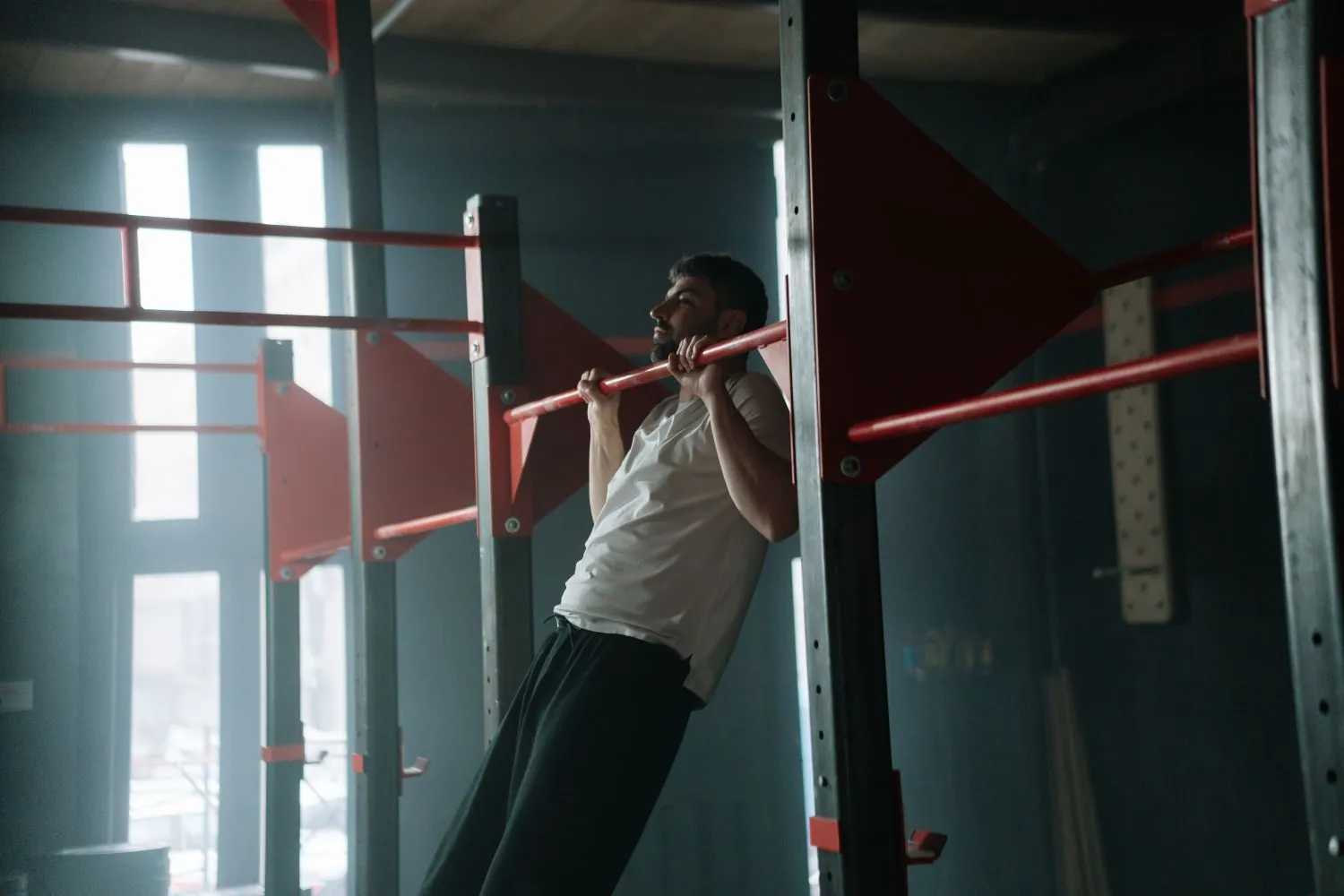
A double bar workout emphasises pushing and core stability (dips, L-sits, leg raises), while a single bar workout emphasises pulling (pull-ups, chin-ups, hanging raises). A T-bar workout is something else entirely: a loaded barbell row for the back. Training both bar types covers push, pull and core.
Most parks put a pull-up bar and parallel bars a few metres apart, so treat them as one station: dips, then pull-ups, with knee raises in between. That balances shoulder work front and back.
To progress toward toes to bar, build leg raise strength on the parallel bars first: knee raises, straight-leg raises, then hanging knee raises on the single bar. Skipping steps is where lower backs get strained.
Frequently asked questions
What is a double bar workout?
A double bar workout is a bodyweight session on two parallel rails using dips, support holds, L-sits and leg raises. It trains the chest, triceps, shoulders and core, needs no equipment beyond the bars found in most Indian parks, and can be scaled from beginner to advanced.
How many times a week should you do a double bar workout?
Two to three times a week works for most people, with at least one rest day between sessions. Keep each session around 25 to 35 minutes and add one rep or a few seconds of hold time per week rather than training on consecutive days.
How many dips should a beginner do on parallel bars?
A beginner should aim for 3 to 4 sets of 5 to 8 partial-range dips with 60 to 90 seconds of rest. If you cannot lower under control yet, begin with support holds and slow negatives, then work toward 8 to 10 clean full-range dips.
Are parallel bar dips bad for your shoulders?
Not when done with control. Problems usually come from flared elbows, bouncing at the bottom or going deeper than your shoulders can handle. Keep your elbows back, lower for 2 to 3 seconds, stop when your upper arms are about parallel, and see a doctor if pain persists.
Can you build muscle with only a double bar workout?
You can build good chest, triceps, shoulder and core strength with parallel bars alone, especially as a beginner. For a balanced physique, add pulling work such as pull-ups or rows and some leg training, and eat enough protein across your Indian meals.
Next step: If you want a coach to check your dip form and build the progression around your strength level, book a 1-on-1 personal training session with Fitstrot and take your park’s parallel bars as the starting point.


