

Yoga for weight loss works, but not the way most Instagram reels suggest. A typical 30-minute hatha class burns about 120–170 kcal, which is similar to a slow walk. The real payoff is somewhere else. Regular yoga is linked to less weight gain over the years, calmer eating and a routine people actually keep up. This guide gives you the calorie numbers, the styles worth your time, a 25-minute sequence you can do at home, and a clear line between what yoga can and can’t do for your waistline.
Two quick notes before we start. Yoga does not replace a calorie deficit. And no pose melts fat from one body part. If you’ve tried yoga before and the scale didn’t move, those two facts probably explain why. Everything below is built around them.
Does yoga for weight loss actually work?
Yes, modestly, and mostly for people who are already overweight. A 2016 meta-analysis of 30 randomised trials (2,173 participants) found no clear effect on weight in the general population. It did find a meaningful drop in BMI among overweight and obese adults compared with usual care. Yoga works best paired with changes to food.
The 2016 review by Lauche and colleagues in Preventive Medicine is the most useful summary we have. It pooled 30 RCTs and found a BMI benefit only in the overweight/obese subgroup. The authors also warn that the result was sensitive to study quality. A later picture from the US National Center for Complementary and Integrative Health points the same way. It describes a 2022 review of 22 studies (1,178 participants) showing reductions in weight, BMI, body fat and waist size. The programmes that worked better ran longer, more frequent sessions (at least 75–90 minutes, three or more times a week) and included a dietary component.
Long-term data is even more interesting. In a US cohort of 15,550 adults aged 53–57, four or more years of regular yoga was linked with 18.5 lb (about 8.4 kg) less weight gain among overweight participants between age 45 and the mid-fifties (Kristal et al., 2005). That study was observational, so it cannot prove cause and effect. What it does suggest is that yoga’s biggest strength is stopping the slow yearly creep, not rapid fat loss.
Calories burned: yoga, walking and the gym side by side
Harvard Health publishes calorie estimates for 30 minutes of common activities at three body weights. We have converted pounds to kilograms and pulled out the rows most people are choosing between. All figures come from Harvard Health’s calories-burned table, except the surya namaskar row, which comes from a separate lab study cited below.
| Activity (30 min) | 57 kg person | 70 kg person | 84 kg person |
|---|---|---|---|
| Hatha yoga / stretching | 120 | 144 | 168 |
| Walking, 5.6 km/h (3.5 mph) | 107 | 133 | 159 |
| Brisk walking, 6.4 km/h (4 mph) | 135 | 175 | 189 |
| Weight lifting, general | 90 | 108 | 126 |
| Low-impact aerobics | 165 | 198 | 231 |
| Stationary cycling, moderate | 210 | 252 | 294 |
| Running, 8 km/h (5 mph) | 240 | 288 | 336 |
| Surya namaskar, 4 continuous rounds (trained, 60 kg)* | ~230 kcal per 30-min session | ||
*From a small study of six trained young adults, so treat it as an upper-end figure, not a promise.
Three things stand out:
- A gentle hatha class is roughly equal to walking. Lab data backs this up. When 20 experienced practitioners did a 56-minute beginner hatha video inside a calorimeter, the session averaged 2.5 METs and 3.2 kcal/min. That is the same intensity as walking at 3.2 km/h (Hagins et al., 2007). The sun salutation segment was higher at 2.9 METs.
- Pace changes everything. When surya namaskar is done as continuous rounds, it becomes real cardio. In a study of Asian Indian practitioners, four rounds pushed heart rate to an average of 80% of age-predicted maximum and burned about 230 kcal in a 30-minute session for a 60 kg person (Mody, 2011).
- Weight lifting burns fewer calories in the moment but builds muscle. That is why the best plans combine both instead of choosing one.
Put that into weekly terms. Three 30-minute hatha sessions at 70 kg burn around 430 kcal a week. A kilogram of body fat stores roughly 7,700 kcal. On calorie burn alone, gentle yoga would take about 4 months to remove 1 kg. That’s why food and daily movement matter more, and why yoga’s value lies in the behaviour changes covered further down.
Which is the best yoga for weight loss?
The best yoga for weight loss is the most vigorous style you can practise safely three to five times a week. For most people that means a flowing, surya namaskar-heavy class (vinyasa or power yoga), plus one slower hatha or yin session for recovery. Intensity matters, but consistency over 12+ weeks matters more than any single style.
| Style | What a class looks like | Intensity | Best for | Watch out for |
|---|---|---|---|---|
| Hatha | Poses held 20–60 s with rests | Light: ~2.5 METs, similar to a slow walk (Hagins 2007) | Beginners, mobility, stress | Too gentle to drive a big calorie burn alone |
| Surya namaskar rounds | 12-pose cycle repeated back to back | 2.9 METs at slow pace; ~80% HRmax when done continuously (Mody 2011) | Home practice, limited time | Wrist and lower-back strain if form breaks |
| Vinyasa | Continuous flow linking breath and movement | Moderate if you keep moving; depends on the teacher’s pace | People who get bored holding poses | Rushed transitions from plank to cobra |
| Power yoga | Strength-focused flow, longer holds, some jumps | Moderate to vigorous for fit practitioners | Those who already exercise | Not a beginner’s first class |
| Yin / restorative | Floor poses held 2–5 min, props | Very light | Recovery, sleep, stress eating | Burns little; use it as an add-on |
| Hot / Bikram | Set sequence in a heated room | Feels hard; the sweat is mostly water | Experienced, heat-tolerant people | Dehydration; not advised in pregnancy (NCCIH) |
Power yoga for weight loss
Power yoga borrows the structure of Ashtanga but drops the fixed sequence. You get chair-pose holds, lunges, chaturanga push-ups and plank work stacked together, so your muscles stay under tension and your heart rate stays up. For someone who can already manage 10 minutes of continuous surya namaskar, 2–3 power classes a week is the quickest way to raise yoga’s calorie burn. If your wrists, shoulders or knees are unhappy, work up to it over 4–6 weeks.
Vinyasa yoga for weight loss
Vinyasa sits between hatha and power. The key variable is how long you spend resting in child’s pose. A class that flows for 35 of its 45 minutes is a genuine moderate workout. One that pauses every two poses to explain alignment is closer to hatha. Ask the teacher, or watch the first ten minutes of a recorded class, before signing up.

Home yoga for weight loss: a 25-minute sequence
This routine front-loads the calorie-dense work (surya namaskar and standing poses) while your energy is highest. It then moves to core and finishes with a proper cool-down. You need a mat and enough space to stretch your arms out. Do it on an empty stomach or 2–3 hours after a main meal.
| # | Pose / block | Hold or reps | Time | Easier option |
|---|---|---|---|---|
| 1 | Seated breathing + neck and shoulder rolls | 10 slow breaths, 5 rolls each way | 2 min | Sit on a cushion or chair |
| 2 | Marjaryasana–Bitilasana (cat–cow) | 10 slow rounds | 1 min | Fold the mat under your knees |
| 3 | Surya namaskar | 6 rounds; first 2 slow, last 4 steady | 7 min | Knees down in plank; half cobra |
| 4 | Utkatasana (chair pose) | 3 × 30 s, 15 s rest | 2 min | Shallower bend, hands on hips |
| 5 | Virabhadrasana II (warrior II) | 2 × 40 s each side | 3 min | Shorter stance |
| 6 | Trikonasana (triangle) | 30 s each side ×1 | 1.5 min | Hand on shin or a block |
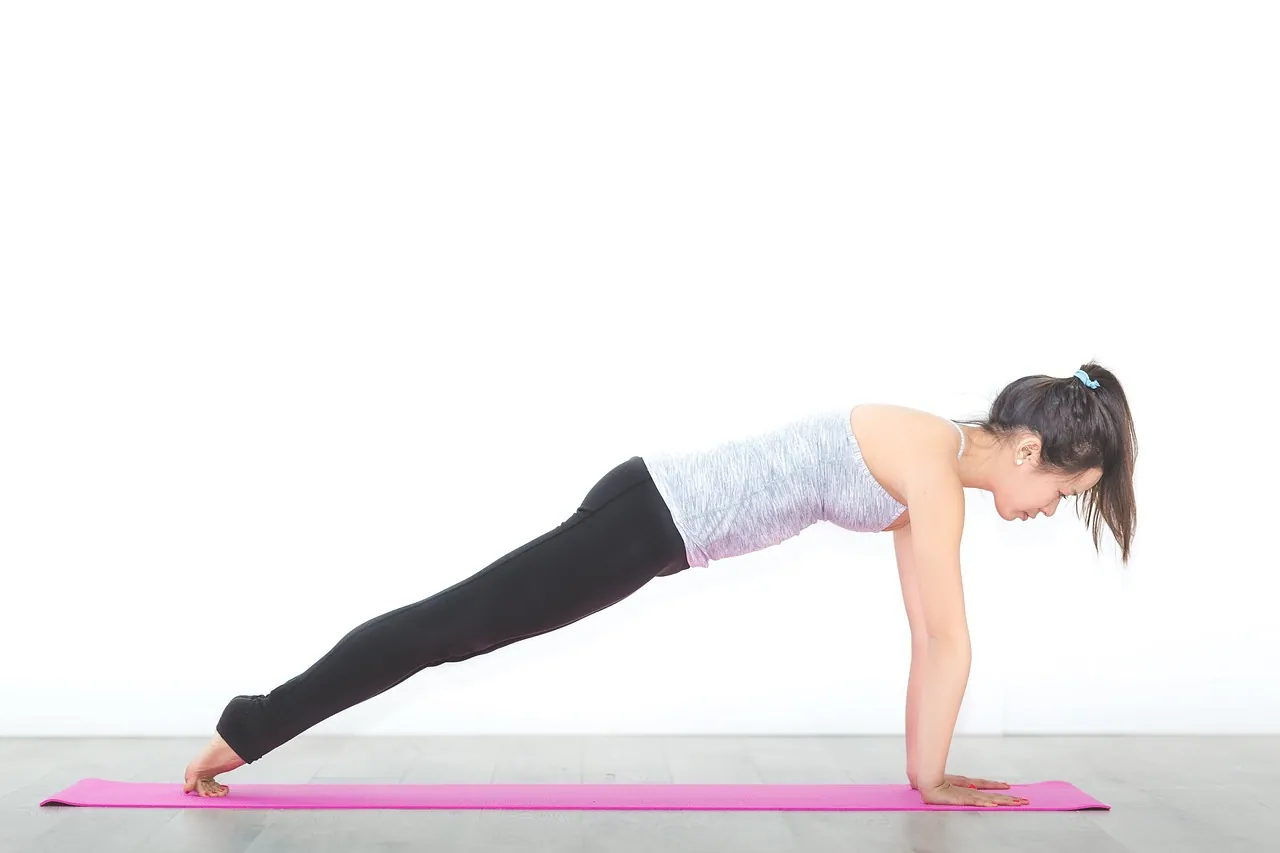
| 7 | Phalakasana (plank) | 3 × 20–40 s | 2 min | Knees down or forearms on a chair |
| 8 | Setu bandhasana (bridge) | 3 × 30 s | 2 min | Lower hips between reps |
| 9 | Naukasana (boat) | 3 × 15–20 s | 1.5 min | Knees bent, hands behind thighs |
| 10 | Supta matsyendrasana (lying twist) | 30 s each side | 1 min | Pillow under the knees |
| 11 | Shavasana | Still, slow breathing | 3 min | Rolled towel under the knees |

Form cues that matter most:
- Surya namaskar: step back to plank rather than jumping until your wrists are used to the load. Keep the lower back long in cobra. If it pinches, lift only as high as your lower ribs.
- Chair and warrior: the knee tracks over the second toe and never collapses inwards. Your thighs should burn. Your knee should not hurt.
- Plank and boat: stop the set when your hips sag or your back rounds. Five good seconds beat 30 poor ones.
Yoga for weight loss for beginners: your first 4 weeks
Starting at full volume is the most common reason beginners quit in week two, usually with sore wrists or a stiff lower back. Build up gradually, and add brisk walking so your weekly total gets close to the CDC’s 150 minutes of moderate activity plus 2 days of muscle-strengthening work.
| Week | Yoga sessions | Surya namaskar rounds | Brisk walks | Total active minutes |
|---|---|---|---|---|
| 1 | 3 × 15 min (steps 1–4, 11) | 3, slow | 2 × 25 min | 95 |
| 2 | 3 × 20 min (add warrior, plank) | 4 | 2 × 30 min | 120 |
| 3 | 4 × 25 min (full sequence) | 6 | 2 × 30 min | 160 |
| 4 | 4 × 25–30 min, or swap one for a vinyasa/power class | 6–8, steady | 2 × 30 min | 160–180 |
A caveat: by the Hagins data, most of a gentle hatha session is light activity, not moderate. Only the faster surya namaskar blocks and brisk walks fully count toward the 150-minute target. The table is a realistic path, not a loophole.

Choosing a yoga for weight loss online class
Free videos are fine for learning pose names. For weight loss, though, the gap between people who succeed and people who drift is usually structure and accountability, not information. Before you pay for any online class, check these five things:
- Is it live, with cameras on? A teacher who can see you will fix a collapsing knee or a sagging plank. That keeps you injury-free long enough for results to show.
- How much of the class is continuous movement? Aim for 60–70% flow in at least two sessions a week.
- Is there a fixed timetable? A 7 a.m. slot you’ve booked beats a “whenever I’m free” plan, which quietly becomes never.
- Does anyone look at your food? The 2022 review cited by NCCIH found better results in programmes with a dietary component.
- Are modifications offered? Knee, back and blood-pressure adjustments should be routine, not an afterthought.
Fitstrot’s live online yoga classes are built around those criteria: small batches, cameras on, and flows planned week by week so you actually progress.
Myth check: yoga for weight loss belly fat claims
No yoga pose burns belly fat specifically. Twists, boat pose and kapalbhati strengthen and move the abdomen, but your body decides where fat comes off first. Waist size drops when overall body fat drops, through a steady calorie deficit, enough protein and sleep, and total weekly activity. Core poses help your posture and strength, not spot reduction.
The “twist to detox your belly” claim comes up a lot on Indian social media. It sounds right because a twist feels like it’s wringing something out. Physiologically, it isn’t removing fat from that spot. What the research does show is that yoga improved waist-to-hip ratio in healthy adults in the Lauche meta-analysis, and waist size in the reviews NCCIH summarises. That happens through whole-body change, alongside better posture from a stronger core. If a short-term flat-stomach goal is what brought you here, our guide on what’s realistic for belly fat in 10 days gives the honest numbers.
Where yoga really pays off: appetite, stress and sticking with it
If yoga’s calorie burn is modest, why does the long-term data look good? Three mechanisms keep coming up.
1. More mindful eating
In a 2009 study that developed the Mindful Eating Questionnaire, yoga practice was associated with higher mindful-eating scores, while walking and moderate or intense exercise were not. Higher scores tracked with lower BMI (Framson et al., J Am Diet Assoc). Practically, this looks like stopping at one serving of rice, or noticing you’re eating chakli out of boredom rather than hunger.
2. A calmer response to stress
Slow breathing and long exhales in shavasana and pranayama shift you out of “fight or flight” mode. Many people find this cuts the 10 p.m. snack that follows a stressful workday. If anxiety or stress is driving your eating, the breathing blocks at the start and end of the sequence above are the parts to protect on busy days.
3. Adherence
A routine you keep for years beats a hard one you quit in a month. Yoga is low-impact, needs no equipment and suits people who dislike gyms, so it tends to stick. That matters, because 31% of adults worldwide don’t meet WHO activity recommendations, and inactive people have a 20–30% higher risk of death than active ones (WHO fact sheet, 2024).
Yoga for weight loss for women: what changes by life stage
The sequence above works for women and men alike. A few situations do need adjustments:
- PCOS: insulin resistance makes diet quality especially important. Pair 4 yoga sessions a week with 2 strength sessions and a structured food plan. Our PCOS weight loss diet guide covers the food side in detail.
- Periods: there is no rule that says you must stop. Many women swap power flows for hatha or yin on heavy-flow days and skip deep inversions if they feel uncomfortable. Listen to your body rather than a blanket ban.
- Pregnancy: NCCIH advises pregnant women to talk with their doctor and instructor first, and to avoid hot yoga because of overheating. Pregnancy is not a time for weight-loss goals.
- After delivery: get your doctor’s go-ahead first, particularly after a C-section. Start with breathing, pelvic floor work and gentle hatha before any plank or boat pose.
- Perimenopause and 40s–50s: muscle loss speeds up in this decade. Power yoga, chair pose and warrior holds count as strength work, but 2 days of resistance training still add the most. This is the age group where the Kristal cohort saw the clearest benefit.
Health conditions also need care. NCCIH lists knee or hip injuries, lumbar spine disease, severe high blood pressure, balance problems and glaucoma as reasons to modify poses. For glaucoma and high BP that usually means avoiding head-below-heart positions. Check with your doctor first if any of these apply to you.
Stuck after a month? Troubleshooting the plateau
If you’ve done yoga regularly for 4–6 weeks and your weight and waist haven’t moved, work through this list in order:
- Your food hasn’t changed. This is the cause most of the time. Adding 430 kcal of burn a week is easily cancelled by one extra samosa and chai each day. Weigh your roti atta or rice for one week to get a reality check. A dietitian consultation can build an Indian meal plan around your routine.
- You’re compensating. “I did yoga, so I’ve earned the mithai” is common and easy to miss. Plan your post-yoga meal in advance: poha with peanuts and curd, besan chilla, or sprouts chaat instead of biscuits.
- Every session is gentle. Make at least two sessions a week flow-based, with 6–8 continuous surya namaskar rounds.
- You’re sitting the rest of the day. One hour of yoga doesn’t undo 10 hours at a desk. Add 20–30 minutes of brisk walking on non-yoga days.
- Your expectations are off. A realistic rate is roughly 0.5–1 kg a week, and slower than that in the first weeks as your body adjusts. Judge progress over 8–12 weeks, not 8–12 days.
- Sleep is short. Less than 6–7 hours makes hunger harder to manage. An evening yin or shavasana-focused session can help you wind down.

Frequently asked questions
How many calories does 30 minutes of yoga burn?
About 120–170 kcal for gentle hatha yoga, depending on body weight: 120 kcal at 57 kg, 144 at 70 kg and 168 at 84 kg (Harvard Health). Continuous surya namaskar can reach around 230 kcal in 30 minutes for a 60 kg trained practitioner (Mody, 2011).
Can I lose weight with yoga alone, without dieting?
Probably only a little. Yoga’s calorie burn is modest, and trials show the best results when yoga is combined with dietary changes. Without a calorie deficit from food, most people see better mobility and mood but little change on the scale.
How often should I do yoga to lose weight?
Aim for 4–5 sessions a week of 25–45 minutes, with at least two flow-based sessions. Reviews summarised by NCCIH found better results with longer, more frequent practice: at least 75–90 minutes, three or more times a week.
Is surya namaskar enough for weight loss?
It is the most effective single yoga practice for calorie burn when done in continuous rounds. It works best as part of a plan that also covers diet, daily steps and two days of strength work.
What is the best time to do yoga for weight loss?
Whenever you’ll do it consistently. Morning sessions on an empty stomach are easier to protect from work and family demands. If evening is your only slot, keep it 2–3 hours after your last main meal.
Is power yoga safe for beginners?
Usually not as a first class. Build 3–4 weeks of hatha and slow surya namaskar first so your wrists, shoulders and core can handle repeated planks and chaturangas. Get medical advice first if you have high blood pressure, glaucoma or joint problems.
Can yoga reduce belly fat specifically?
No. Spot reduction doesn’t happen with any exercise. Yoga can reduce waist size as part of overall fat loss and strengthen the core, which improves posture, but fat comes off the whole body, not just the part you’re working.
Want a teacher to set your pace, correct your form on camera and plan each week’s flow? Book a trial Fitstrot online yoga class and start with the 25-minute sequence above, done properly.


