Introduction: The Biggest Fitness Myth
Walking is one of the most recommended activities for weight loss. It is simple, accessible, and requires no equipment. Many people believe that if they walk daily, especially for 30–60 minutes, they will automatically lose weight. While walking is a great starting point, relying only on walking is one of the biggest reasons people struggle to see real fat loss results.
In real-world coaching experience, most people who depend only on walking either lose very little weight or hit a plateau within a few weeks. This leads to frustration and confusion. The truth is simple: walking helps, but it is not enough on its own.
To understand this properly, we need to break down the science of fat loss, metabolism, muscle, and energy balance in a simple and practical way.
Understanding Weight Loss: The Real Mechanism
Weight loss is driven by a calorie deficit. This means your body must burn more calories than you consume over time. However, not all calorie deficits are equal.
A sustainable fat loss plan depends on:
- Calorie burn (activity level)
- Muscle mass (metabolism driver)
- Hormonal balance (especially insulin)
- Food intake and quality
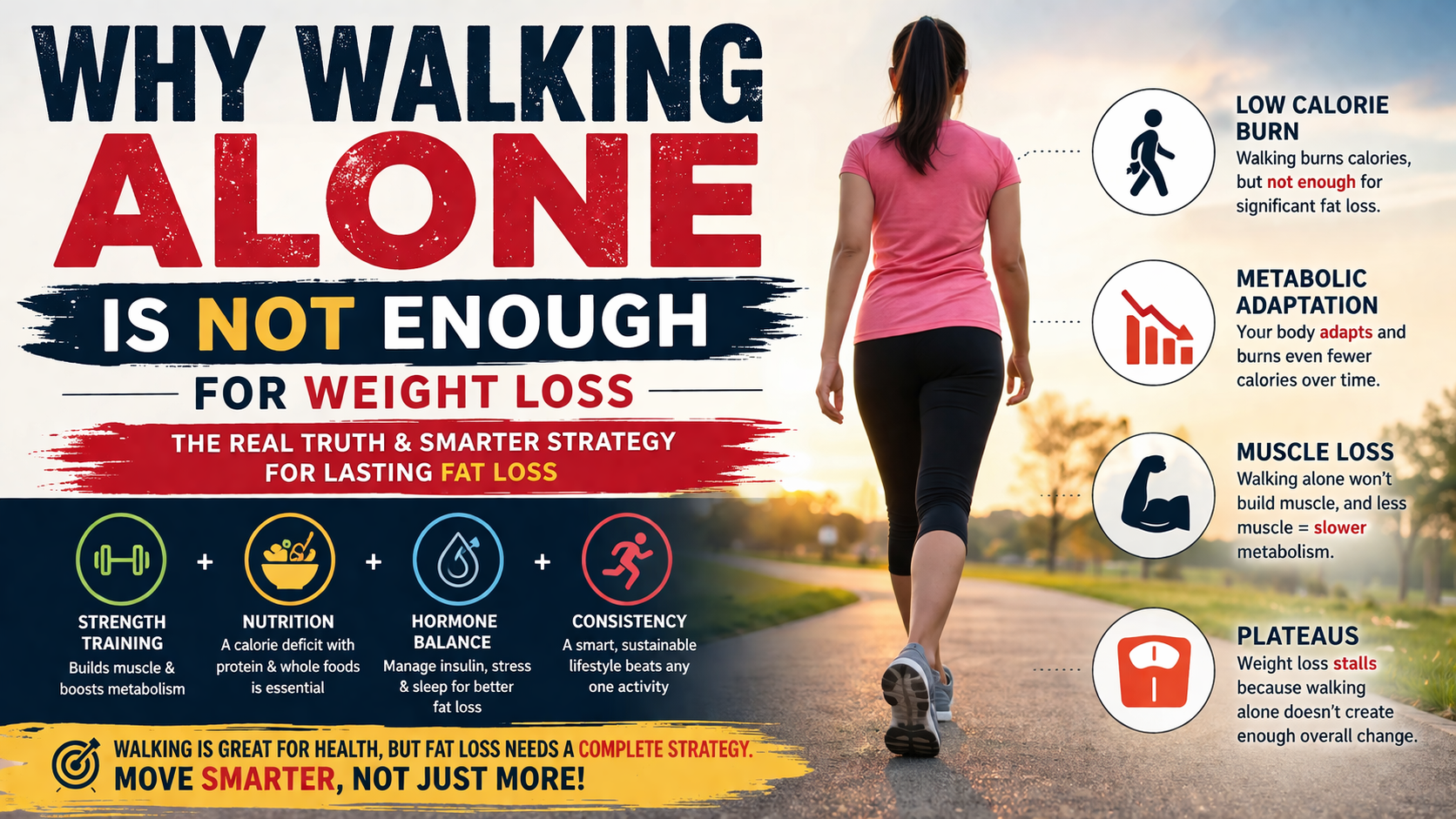
Walking contributes only to one part: calorie burn. But fat loss requires a combination of all factors working together.
Walking is just a part of daily movements and it comes under NEAT (Non- exercise energy thermogenesis), and it is not an exercise. So is not enough for weight loss.
How Many Calories Does Walking Actually Burn?
Walking is a low-intensity activity. For an average 75-85 kg individual, walking burns around 200 calories per hour depending on speed and terrain.
Now compare this:
- Strength training: 300–500 calories/hour
- High-intensity training: 400–700 calories/hour
The gap is significant. This means walking alone creates a very small calorie deficit unless combined with strict dietary control.
Also, many people overestimate calorie burn and unknowingly eat more, cancelling out progress.
Metabolic Adaptation: Why Progress Stops
The human body is highly adaptive. When you perform the same activity repeatedly, your body becomes efficient at it. This means it starts using fewer calories to perform the same walking routine.
This is called metabolic adaptation.
For example:
Week 1: 300 calories burned
Week 6: 220–250 calories burned for the same walk
This reduction slows down fat loss and leads to plateaus. This is why people often say, “I walk daily but my weight is not reducing anymore.”
Muscle Loss: The Hidden Problem
Walking does not build muscle mass. When you lose weight without strength training, your body can lose both fat and muscle.
Muscle is extremely important because:
- It increases resting metabolism
- It helps maintain long-term fat loss
- It improves strength and daily function
Without muscle preservation, your metabolism slows down, making fat loss harder over time.
Hormonal Impact: Why Intensity Matters
Fat loss is not just about calories. Hormones play a critical role.
Higher intensity training improves:
- Insulin sensitivity
- Fat oxidation
- Growth hormone levels
This is especially important for individuals with diabetes or insulin resistance. Walking alone does not create enough stimulus to significantly improve these hormonal responses.
This is why combining walking with strength training and moderate-to-high intensity workouts gives much better results.
The Plateau Problem: Real-Life Scenario
Many people start walking daily and initially lose 2–3 kg. Then progress stops.
This happens because:
- Calorie burn is low
- Body adapts
- No muscle is built
- Nutrition is not controlled properly
Without progression or variation, the body stops responding.
Fat Loss vs Weight Loss
Walking may help reduce weight, but not necessarily fat.
Weight loss can include:
- Water loss
- Muscle loss
- Glycogen depletion
Fat loss is what actually improves health and body composition. Strength training plays a key role in ensuring that most of the weight lost is fat, not muscle.
What Actually Works: The Complete Approach
A sustainable fat loss strategy should include:
1. Strength Training (3–4 times per week)
Build muscle and increase metabolism.
2. Cardio (2–3 times per week)
Include intervals or faster-paced sessions.
3. Daily Activity (Walking)
Use walking as support, not the main tool.
4. Right Personalized Nutrition which can help in muscle preservation and get in caloric deficit for fat loss . Control calorie intake and prioritize protein.
5. Consistency
Long-term adherence matters more than short-term intensity.
This combination creates a powerful fat loss system.
Simple Weekly Structure (Practical Plan)
A practical weekly structure can look like:
- Monday: Strength Training
- Tuesday: Walking + Light Cardio
- Wednesday: Strength Training
- Thursday: Walking
- Friday: Strength Training
- Saturday: Active Lifestyle (some sports)
- Sunday: Rest
This structure balances recovery, intensity, and sustainability.
Conclusion: Walking Is not the Solution
Walking is excellent for general health. But it should not be your only strategy for weight loss.
If your goal is real fat loss, better metabolism, and long-term results, you need a structured approach that includes strength training, proper nutrition, and progressive overload.
Think of walking as a foundation, not the full system.
The people who get the best results are not the ones who walk the most—they are the ones who train smart, eat right, and stay consistent over time.