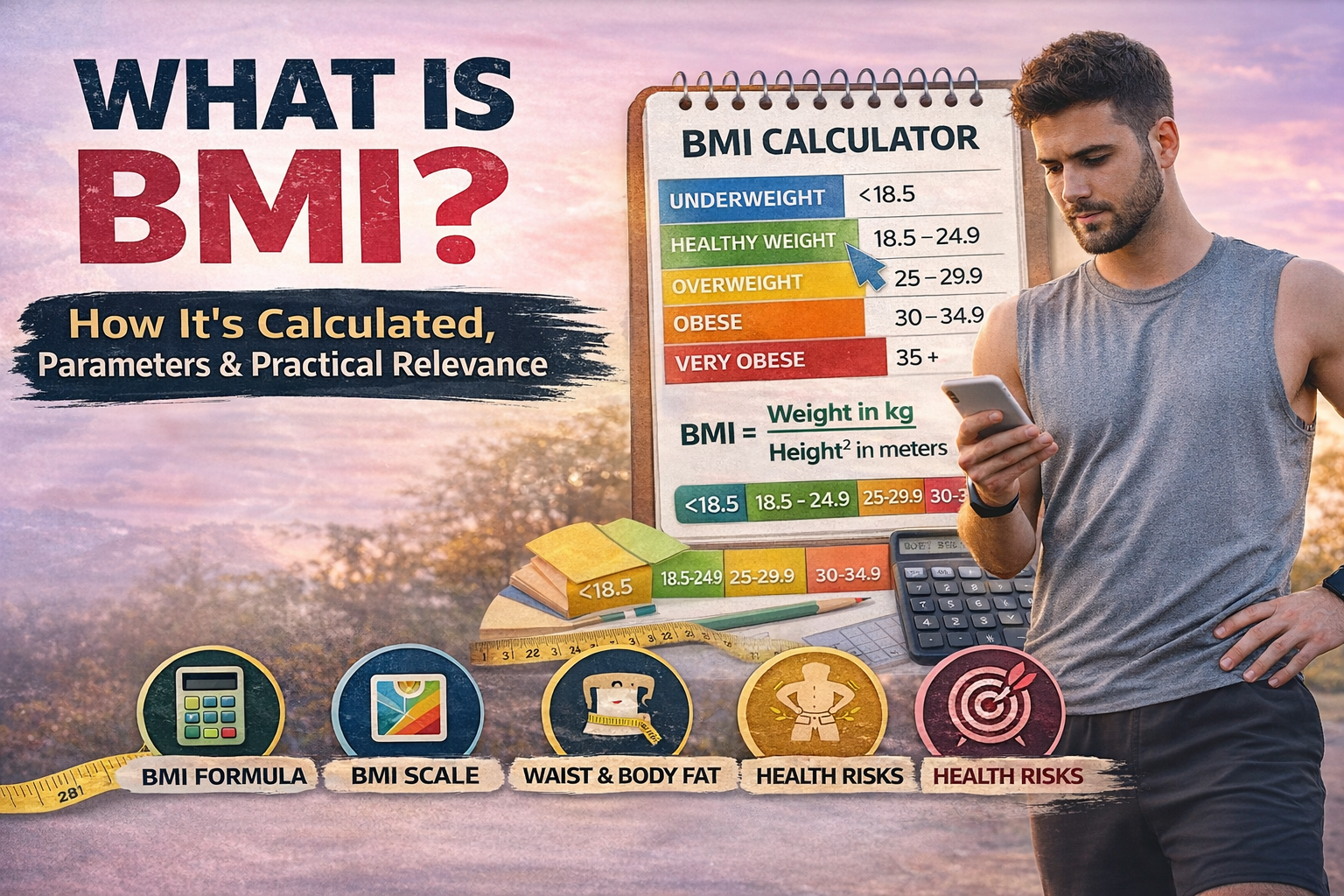
What is BMI: Importance, Calculation, Parameters & Practical Relevance
Introduction: Beyond Just a Number
Body Mass Index (BMI) is one of the most widely used tools in health and fitness. But for most people, it is either misunderstood or oversimplified.
Many individuals check their BMI once, see a number, and either panic or ignore it. But BMI is not just a number—it is a screening tool that, when used correctly, can provide valuable insights into your health, metabolic risk, and starting point for transformation.
In this article, we will break down BMI scientifically and practically so you can use it as a powerful tool—not a limitation.
What is BMI?
BMI (Body Mass Index) is a ratio of your weight to your height. It helps estimate whether your body weight falls within a healthy range.
Formula:
BMI = Weight (kg) / Height (m²)
It is simple, quick, and widely used in medical settings. However, it does not directly measure body fat, which is why interpretation matters.
How to Calculate BMI (Practical Example)
Example:
Weight = 90 kg
Height = 1.72 meters
BMI = 90 ÷ (1.72 × 1.72)
BMI ≈ 30.4
This falls into the obese category.
Understanding this calculation helps you track and interpret your progress better rather than blindly relying on apps.
BMI CALCULATOR LINK:
https://www.calculator.net/bmi-calculator.html
BMI Categories: Global vs Indian Context
WHO Standard:
- Underweight: <18.5
- Normal: 18.5–24.9
- Overweight: 25–29.9
- Obese: 30+
Asian/Indian Context:
- Normal: 18.5–22.9
- Overweight: 23–24.9
- Obese: 25+
This is important because Indians have higher fat percentage at lower BMI, increasing risk of diabetes and heart disease.
Why BMI is Important (Scientific Perspective)
BMI is strongly linked to chronic disease risk.
Higher BMI is associated with:
- Type 2 diabetes
- Cardiovascular disease
- Hypertension
- PCOS and hormonal imbalance
Lower BMI(underweight) risks include:
- Weak immunity
- Nutritional deficiencies
- Muscle loss
BMI acts as an early warning system.
BMI vs Body Fat Percentage
BMI does not differentiate between muscle and fat.
Example:
- A muscular individual may have high BMI but low fat
- A sedentary person may have normal BMI but high fat (skinny fat)
This is why body fat percentage is a better indicator, but BMI is still useful for large-scale screening.
Limitations of BMI
BMI has limitations:
- No distinction between muscle and fat
- Does not show fat distribution
- Cannot assess fitness level
- May misclassify athletes
Therefore, BMI should never be used alone for decision-making.
Practical Relevance in Real Fitness Coaching
In real coaching scenarios, BMI is used as a starting point.
We combine BMI with:
- Waist circumference
- Strength levels
- Energy levels
- Lifestyle habits
Fat loss, not just weight loss, is the goal.
How to Use BMI Correctly
Step 1: Calculate BMI
Step 2: Check category (use Indian standards)
Step 3: Measure waist circumference
Step 4: Start strength training
Step 5: Improve diet quality
Step 6: Track fat loss and body fat percentage, not just weight
This approach ensures sustainable results.
Final Takeaway: Smart Fitness Approach
BMI is a tool—not a judgment.
Use it to:
- Identify risk
- Set starting point
- Track direction
But focus on:
- Building muscle
- Reducing fat
- Improving health markers
The goal is not just a “normal BMI,” but a strong, healthy, and sustainable body.